Ingredient reference
Vitex (Chaste Tree)
Vitex agnus-castus · Lamiaceae
Native range
Mediterranean basin and western Asia, including southern Europe and Bulgaria
Part used
Berries (fruit)
Key compounds
Casticin, Vitexin, Agnuside, Aucubin, Rotundifuran
Traditional use
Used in European women's herbalism since at least the 4th century BC for women's wellness
What is vitex?
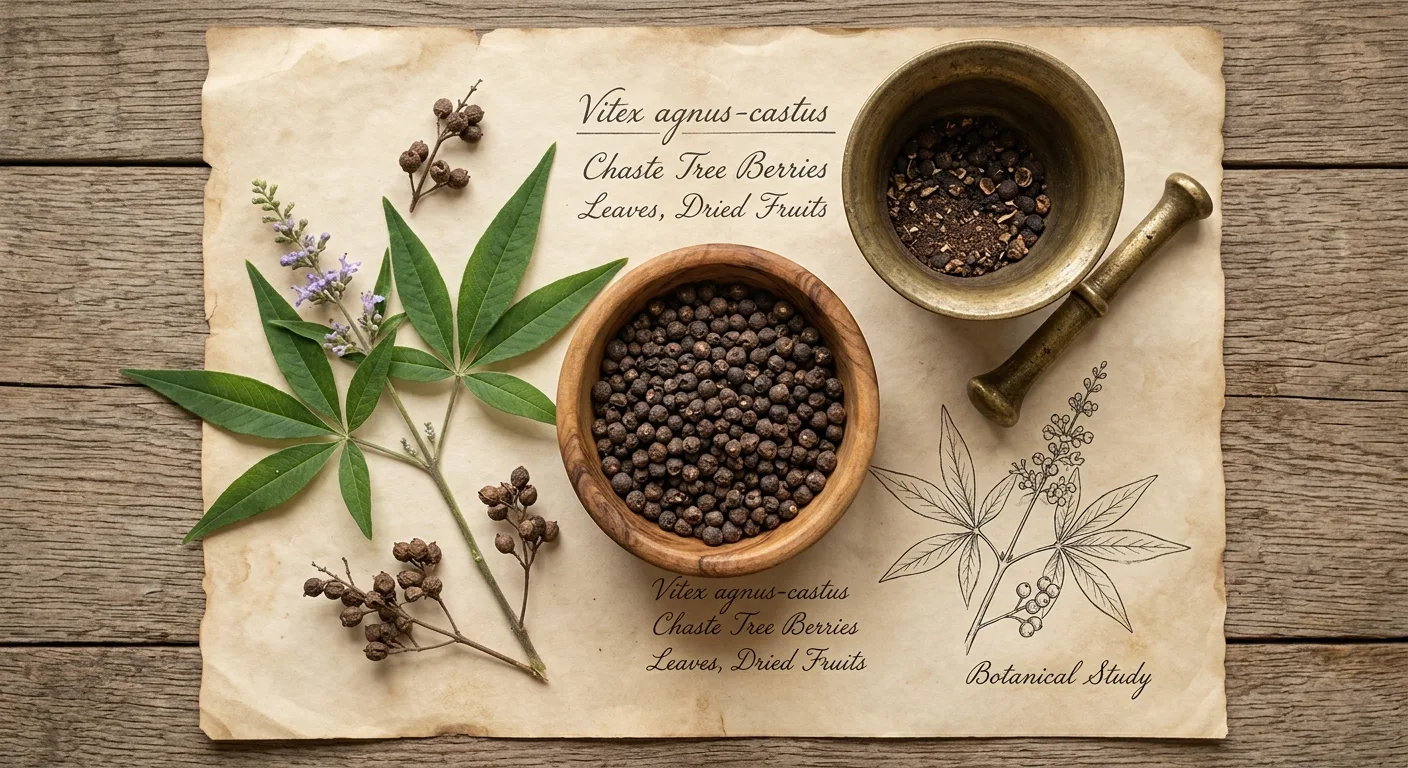
Vitex (Vitex agnus-castus), commonly known as chaste tree or chasteberry, is a deciduous shrub of the Lamiaceae family — the same family as mint, rosemary, lavender and sage. It typically reaches two to five metres in height, with slender, aromatic grey-green leaves divided into finger-like leaflets and long spikes of small lilac to blue-violet flowers in summer. The flowers give way to small, dark, peppercorn-sized berries that ripen in autumn. It is the dried berries, rather than the leaves or flowers, that have been the primary part used in European herbal medicine for over two thousand years.
The Latin species name agnus-castus is a bilingual compound: the Greek agnos means 'chaste' or 'pure' and the Latin castus reinforces the same meaning. This naming traces back to an ancient belief that the plant helped maintain chastity — Greek women reportedly placed vitex branches on their beds during religious festivals honouring Demeter, and medieval European monks were said to grind the dried berries as a pepper substitute, hence the German name Monchspfeffer ('monk's pepper'). These folk traditions reflect the deep historical association between vitex and women's wellness in the European herbal tradition.
Today vitex is one of the most widely used traditional botanicals in the European supplement market. It is sold as a standalone extract and as a key ingredient in multi-botanical formulas aimed at women's wellness. While vitex itself does not carry an EFSA-approved health claim, it is frequently combined with vitamin B6, which has an EFSA-approved claim for contributing to the regulation of hormonal activity — a pairing that reflects the traditional rationale for using vitex in the first place.
Where does vitex grow?
Vitex agnus-castus is native to the Mediterranean basin and western Asia. Its natural range stretches from the Atlantic coast of southern Portugal and Morocco, across the entire northern Mediterranean — through Spain, southern France, Italy, the Balkans and Greece — and eastward through Turkey and Iran into Central Asia. It thrives in warm, dry climates with long summers, particularly along riverbanks, stream beds and coastal lowlands where the soil retains some moisture but drainage is good.
In southeastern Europe, vitex grows wild in Bulgaria, particularly in the warmer coastal zones along the Black Sea and in the Struma and Mesta river valleys in the southwest. It is also found in Greece, Turkey and across the Adriatic coast. The plant is notably drought-resistant once established, which makes it well-adapted to the hot, dry summers characteristic of the Mediterranean climate zone. Wild populations can form dense thickets along watercourses, sometimes reaching the size of a small tree.
History of use in European herbalism
The recorded use of vitex in European medicine begins with the ancient Greeks. Hippocrates, writing in the 4th century BC, recommended the plant for women's wellness — making vitex one of the oldest documented botanicals in European women's herbalism with a continuous tradition spanning approximately 2,400 years. Hippocrates described the fruit as useful for conditions related to the female cycle, establishing a pattern of use that would persist throughout European medical history.
In the 1st century AD, the Greek physician Dioscorides included vitex in his De Materia Medica — the most influential pharmacological text of the ancient world, which remained the standard European reference for over 1,500 years. Dioscorides described the fruit and leaves as useful for women's wellness and as an aid to reproductive health. The Roman naturalist Pliny the Elder also wrote about vitex in his Natural History, noting its traditional association with women's well-being and its use in religious ceremonies.
Throughout the medieval period and into the Renaissance, vitex remained a fixture of European herbal medicine. It appeared in the monastery gardens of central Europe, where monks cultivated it both for herbal use and as the pepper substitute that gave rise to the German name Monchspfeffer. The 16th-century Italian physician and botanist Pietro Andrea Mattioli included vitex in his illustrated commentaries on Dioscorides, and the plant was described in virtually every major European herbal from that period onward. Unlike many historical botanicals whose traditional uses shifted significantly over time, vitex has been remarkably consistent — it has been associated primarily with women's wellness from antiquity to the present day.
Phytochemistry: what does vitex contain?
The dried berries of Vitex agnus-castus contain a complex mixture of bioactive compounds spanning several chemical classes. Modern phytochemical analysis has identified three main groups of interest: flavonoids, iridoid glycosides and diterpenes. These groups work in concert rather than in isolation, which is why vitex extracts are typically used as whole-berry preparations rather than single-compound isolates.
The flavonoid fraction includes casticin and vitexin, among others. Casticin is a polymethoxylated flavone that has attracted particular research interest and is sometimes used as a marker compound for standardisation of vitex extracts. Vitexin is a C-glycosyl flavone also found in hawthorn and passionflower, and it is the compound from which the plant genus takes its modern scientific name.
The iridoid glycoside fraction contains agnuside and aucubin as the principal compounds. Agnuside is particularly characteristic of Vitex agnus-castus and is used alongside casticin as a quality marker in European pharmacopoeial monographs. Aucubin is more widely distributed in nature and is found in several other Lamiaceae and Plantaginaceae species.
The diterpene fraction includes compounds such as rotundifuran and vitexilactone. Modern phytochemical research has focused considerable attention on the diterpene fraction, as these compounds appear to be among the most pharmacologically active constituents of the berry. The overall phytochemical profile of vitex is well characterised in the European pharmacopoeial literature and has been the subject of extensive analytical work over the past three decades.
How is vitex used today?
In modern European supplement practice, vitex is primarily used in the context of women's wellness. The dried berry is available as a standalone extract in capsule or tablet form, and it is a common ingredient in multi-botanical formulas designed for women. Typical supplement doses range from 200mg to 400mg of dried berry per day, with some standardised extracts concentrated at ratios of 6:1 or 10:1 and dosed at lower absolute weights.
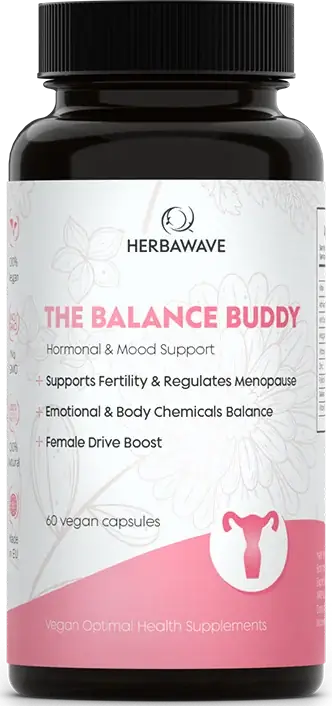
In the HerbaWave Balance Buddy formula, vitex is present at 300mg per serving — a dose at the higher end of what European supplements typically provide. It is paired with ashwagandha (260mg), MYO-inositol (250mg), and a carefully selected panel of vitamins and minerals. The vitamin B6 in the formula carries the EFSA-approved health claim for contributing to the regulation of hormonal activity, which aligns with the traditional rationale for using vitex in women's wellness formulas.
Beyond supplements, vitex remains a popular plant in European ornamental horticulture. It is grown in gardens throughout southern and central Europe for its attractive blue-violet flowers and aromatic foliage, and it is increasingly planted in northern European gardens as climate conditions allow. The essential oil distilled from vitex leaves and flowers is used in some aromatherapy traditions, though this is a distinct application from the berry-based supplement use.
Safety considerations
Vitex agnus-castus has a long safety record spanning over two thousand years of documented use in European herbalism. At the doses typically found in modern supplements (200-400mg of dried berry per day), vitex is generally well tolerated by most adults. The most commonly reported side effects in the modern literature are mild and include occasional digestive discomfort, headache, or skin reactions — all uncommon and typically resolving without intervention.
However, because vitex has a traditional association with women's wellness and the female cycle, there are important safety considerations. Vitex may interact with hormonal contraceptives and other hormonal medications, and anyone taking such medications should consult their doctor before using vitex supplements. Vitex is NOT recommended during pregnancy or breastfeeding — not because harm has been specifically demonstrated, but because there is insufficient research to confirm safety during these periods.
As with all herbal supplements sold in the EU, vitex products are regulated as food supplements, not as medicines. They must comply with EU food safety standards and labelling requirements but do not undergo the same pre-market authorisation process as pharmaceutical drugs. If you are considering adding a vitex supplement to your routine, please consult your healthcare provider, particularly if you are taking any prescription medication, are pregnant or breastfeeding, or have a hormone-sensitive condition.
Frequently asked questions
What is vitex (chaste tree) used for? ▾
Vitex agnus-castus has been used in European women's herbalism since at least the 4th century BC, when Hippocrates recommended it for women's wellness. Today it is primarily found in supplement formulas designed for women's well-being. The dried berry is the part used in modern supplements, typically at doses between 200mg and 400mg per day.
Can I take vitex while on hormonal contraceptives? ▾
Vitex may interact with hormonal contraceptives due to its traditional association with women's hormonal wellness. If you are taking any hormonal medication — including oral contraceptives, hormone replacement therapy, or other hormonal treatments — you should consult your doctor before taking vitex supplements. This is a precautionary recommendation based on the traditional use profile of the plant.
Is vitex safe during pregnancy or breastfeeding? ▾
Vitex is NOT recommended during pregnancy or breastfeeding. This is a precautionary stance rather than a response to documented harm — there is simply insufficient research to confirm safety during pregnancy and lactation. As with all herbal supplements, please consult your doctor before taking any supplement if you are pregnant, breastfeeding, or planning to become pregnant.
Does vitex have any EFSA-approved health claims? ▾
No specific EFSA-approved health claim currently exists for Vitex agnus-castus. It is treated as a traditional botanical in EU supplement regulation. However, vitamin B6 — which is frequently paired with vitex in supplement formulas — has an EFSA-approved claim for contributing to the regulation of hormonal activity. In the HerbaWave Balance Buddy formula, this B6 claim is the centrepiece micronutrient claim alongside the traditional botanical components.
How long has vitex been used in European herbalism? ▾
Vitex has one of the longest documented histories of any botanical in European women's herbalism. Hippocrates recommended it in the 4th century BC, Dioscorides included it in De Materia Medica in the 1st century AD, and Pliny the Elder wrote about it around the same period. This places the documented European use at approximately 2,400 years — an essentially unbroken tradition from ancient Greece to the modern European supplement market.
What are the active compounds in vitex berries? ▾
The dried berries contain three main groups of bioactive compounds: flavonoids (including casticin and vitexin), iridoid glycosides (including agnuside and aucubin), and diterpenes (including rotundifuran and vitexilactone). These compound groups are well characterised in the European pharmacopoeial literature, and casticin and agnuside are commonly used as quality markers for extract standardisation.
Why is it called 'chaste tree' or 'monk's pepper'? ▾
The names reflect ancient beliefs about the plant. The Latin binomial agnus-castus combines the Greek agnos ('chaste') with the Latin castus (also 'chaste'). Greek women reportedly placed vitex branches on their beds during festivals honouring Demeter, believing the plant helped maintain purity. In medieval Europe, monks in monastery gardens reportedly ground the dried berries as a pepper substitute — hence Monchspfeffer ('monk's pepper') in German. Both names point to the same longstanding cultural association between the plant and chastity, which predates and runs parallel to the herbal tradition of using vitex for women's wellness.
How much vitex is in HerbaWave Balance Buddy? ▾
Balance Buddy contains 300mg of dried vitex berry per serving (2 capsules per day). This places it at the higher end of what European supplements typically provide. The vitex is sourced from Mediterranean European producers and is combined with ashwagandha (260mg), MYO-inositol (250mg), vitamin B6 (24mg), and a supporting panel of vitamins and minerals.