The metabolic system
Pillar · MetabolicYour liver, insulin sensitivity, and the system that ages first
The liver, in one paragraph
Your liver is the largest internal organ and the metabolic clearinghouse for almost everything else. Every drop of blood from your intestines passes through it before reaching the rest of your body. It converts carbohydrates, fats, and proteins into usable energy, builds and breaks down cholesterol, produces bile that lets you absorb fats and fat-soluble vitamins, stores iron and B vitamins, and clears toxins, hormones, alcohol, and most pharmaceuticals.
When the liver is healthy, you don't think about it. When it's stressed, the symptoms are mostly metabolic — fatigue, weight gain, lipid shifts, brain fog — and rarely point at the organ itself. That's the central problem of liver health: by the time you feel it, you've been drifting for years.
The aging curve, by decade
Liver function has significant reserve; clinical symptoms typically appear only after substantial impairment. But several measurable trends start drifting after age 30 and become visible in routine lab panels by 40–50.
Hepatic insulin sensitivity falls. The liver becomes less responsive to insulin's signal to stop producing glucose, contributing to higher fasting blood sugar and the slow road to metabolic dysfunction. Non-alcoholic fatty liver disease — fat accumulation in liver cells unrelated to alcohol — is common in middle-aged European adults, often silently.
Lipid panels shift. LDL cholesterol and triglycerides typically climb from the late 30s, while HDL trends down. Bile production becomes less efficient, which affects fat digestion and the elimination of cholesterol. Liver volume and blood flow both decrease modestly with age, reducing the organ's overall processing capacity.
What accelerates the decline
Three lifestyle factors do most of the damage: chronic alcohol intake, ultra-processed food (especially fructose-heavy beverages and refined seed oils), and sedentary habits with visceral fat accumulation. Each amplifies the others.
Alcohol metabolism produces acetaldehyde, a known hepatotoxin. Beyond the obvious — fatty change, fibrosis — chronic moderate drinking measurably raises liver enzymes over years. Industrial fructose (corn syrup, juice concentrates) is metabolized almost exclusively in the liver and converts directly to fat at high daily intake. Visceral fat itself releases inflammatory signals that drive hepatic insulin resistance.
Less obvious accelerants: chronic short sleep (raises cortisol, impairs glucose metabolism), some prescription medications at high doses, environmental toxins (industrial solvents, certain pesticides), and the cortisol-glucose axis activated by chronic stress.
What the research suggests for botanicals
European herbal medicine has used a small set of liver-supporting plants for centuries — and modern phytochemistry has identified the mechanisms behind many of them. None replace lifestyle; all support it.
Milk thistle (Silybum marianum) — its active compound silymarin is one of the most-studied botanicals in modern phytotherapy, with hundreds of clinical and pre-clinical papers. EFSA recognizes its traditional use for liver function support. Silymarin acts as an antioxidant, supports hepatocyte membrane stability, and modulates inflammatory signaling.
Artichoke (Cynara scolymus) — leaf extract has been studied for cholagogue effects (supporting bile flow) and lipid-balance effects in adults. Multiple human trials have observed modest reductions in LDL cholesterol and triglycerides at standardized doses.
Dandelion (Taraxacum officinale) — root has a long European tradition as a bitter that supports digestion and the body's natural elimination pathways. Modern clinical evidence is less robust than for milk thistle, but the traditional pharmacognosy and the plant's bitter-tonic mechanism are well-documented in European herbal monographs.
Burdock (Arctium lappa) — long history in European depurative formulas. Contains inulin-type fructans (prebiotic effect) and arctigenin; contemporary research focuses on antioxidant and hepatoprotective mechanisms in vitro and in pre-clinical models.
What the research doesn't claim: no botanical reverses fibrosis or cirrhosis, and none substitute for reducing alcohol, controlling weight, or improving insulin sensitivity through diet and movement. They support. They don't replace.
Liver Wellness — what's in it and why
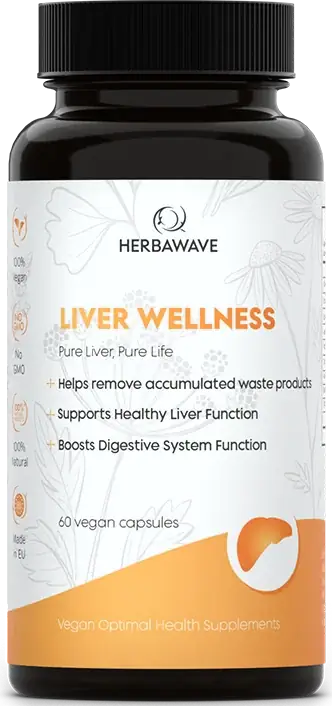
Liver Wellness combines four standardized European botanicals — milk thistle (silymarin), artichoke leaf, dandelion root, and burdock root — with supporting cofactors. The formula is the daily preventive layer for the metabolic system in the HerbaWave longevity stack.
Most customers take it once daily with food. The product is designed for years-long daily use, not 30-day cycles. Used alongside lifestyle improvements — reducing alcohol, controlling refined-carbohydrate intake, regular movement — it's the slow, daily botanical layer of a long-term metabolic health practice.
The basics that do the heavy lifting
Supplements support. Lifestyle does the heavy lifting. For metabolic and liver health, the evidence-supported priorities are well-established.
Alcohol — under 5 standard drinks per week with several alcohol-free days, or ideally none. The data is clear: any chronic intake raises liver enzymes over years. Sugar and refined carbohydrates — minimize added sugars (especially fructose-heavy drinks) and ultra-processed foods. The fructose-to-fat conversion happens almost exclusively in the liver.
Movement — 150+ minutes of moderate aerobic activity per week, plus 2–3 strength sessions. Both directly improve hepatic insulin sensitivity and reduce visceral fat. Sleep — 7–9 hours. Chronic short sleep raises cortisol and impairs glucose metabolism, both of which strain the liver.
Fiber — 30+ grams daily from whole foods. Soluble fiber binds bile acids in the gut, which forces the liver to produce more from circulating cholesterol — directly lowering LDL. Get the basics first; the botanical layer is the fifth, not the first.