Ingredient reference
Cascara Sagrada
Frangula purshiana · Rhamnaceae
Native range
Pacific Northwest of North America (Oregon, Washington, British Columbia, northern California)
Part used
Bark
Key compounds
Cascaroside A, Cascaroside B, Cascaroside C, Cascaroside D
Traditional use
Used by Pacific Northwest indigenous peoples and in Western herbalism since the 1870s as a stimulant herb for intestinal motility
What is cascara sagrada?
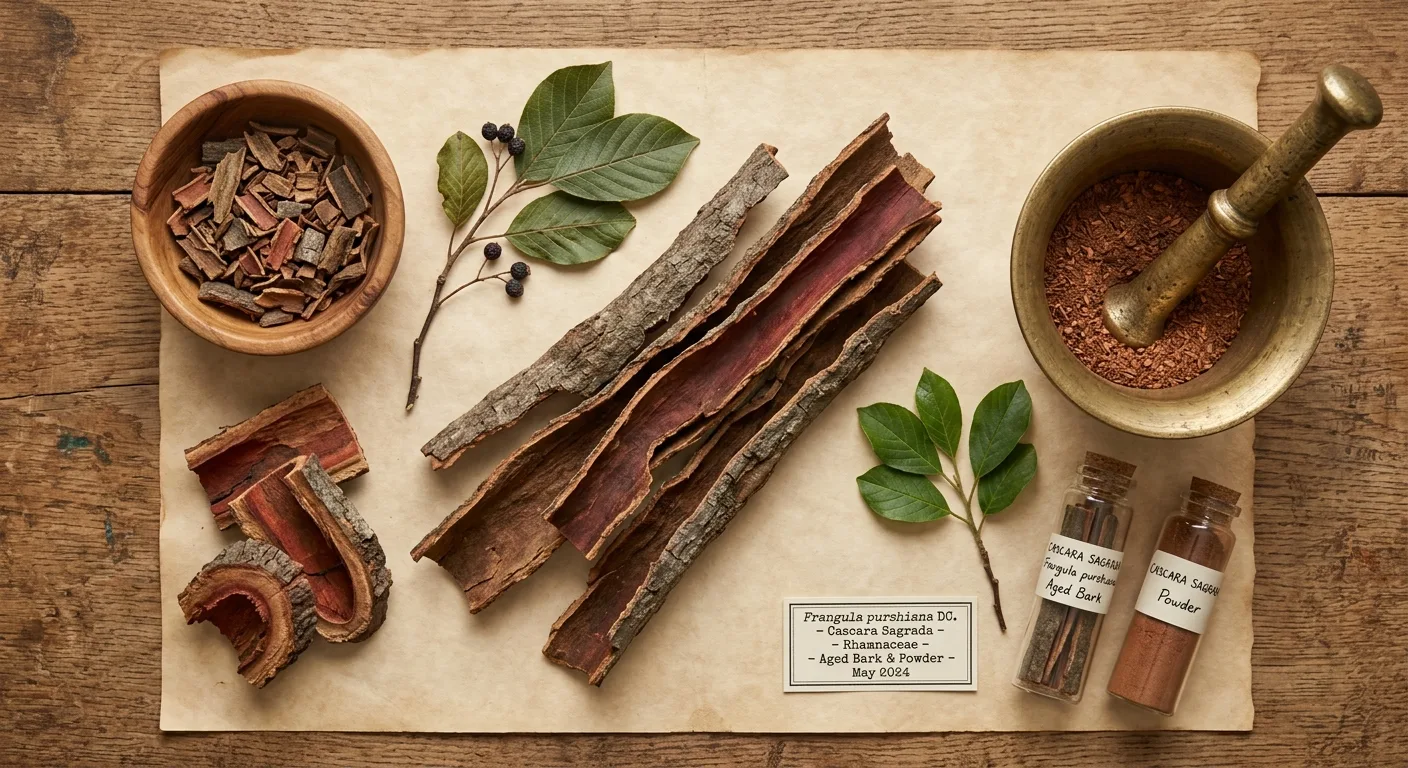
Cascara sagrada (Frangula purshiana, formerly classified as Rhamnus purshiana) is a small deciduous tree or large shrub of the Rhamnaceae family — the same family as common buckthorn and jujube. It typically grows to 5-10 metres in height, with thin, smooth, greyish-brown bark and elliptical leaves that are finely serrated along their edges. The bark, not the leaves or berries, is the part used in herbal practice. The tree produces small, inconspicuous greenish-yellow flowers and dark purple to black berries that are eaten by birds, which is how the seeds are dispersed through Pacific Northwest forests.
The name 'cascara sagrada' means 'sacred bark' in Spanish. It was given by Spanish explorers and missionaries who encountered the tree in the Pacific Northwest and learned of its use from indigenous peoples. The Latin genus name Frangula refers to the brittle nature of the bark (from Latin frangere, 'to break'), while the species name purshiana honours the German-American botanist Frederick Traugott Pursh, who published one of the first formal descriptions of the plant in 1814 during the Lewis and Clark era of Pacific Northwest botanical exploration.
Unlike many European medicinal herbs with millennia of documented written use, cascara sagrada entered the Western herbal pharmacopoeia relatively recently — in the 1870s. However, its use by indigenous peoples of the Pacific Northwest predates European contact by many centuries, making it one of the most significant herbal contributions from the Americas to global herbal practice. Today Frangula purshiana bark is listed in the pharmacopoeias of numerous countries and remains one of the best-known herbal materials in the world.
Where does cascara sagrada grow?
Frangula purshiana is native to the coastal and mountain forests of the Pacific Northwest, from southern British Columbia in Canada through Washington and Oregon to northern California. It is an understorey tree, meaning it grows naturally beneath the canopy of taller conifers — Douglas fir, western red cedar, Sitka spruce — in the moist, temperate rainforests that characterise the Pacific Northwest coastal strip. It prefers well-drained soils with plenty of moisture, from sea level up to around 1,500 metres elevation.
The tree is also found scattered through the interior mountain ranges of the Pacific Northwest — the Cascades, the northern Rockies, the mountains of Idaho — but always in moist, shaded conditions. It does not tolerate dry, open grasslands or hot desert climates. In ecological terms, Frangula purshiana is what botanists call a 'gap species' — it colonises openings in the forest canopy created by fallen trees or natural disturbances, growing quickly in the temporary sunlight before being shaded out again as the canopy closes. This ecological strategy is part of why the tree has been relatively easy to wild-harvest sustainably — it regenerates readily in disturbed forest areas.
Historically, the Pacific Northwest indigenous peoples — particularly the Salish, Chinook, and other coastal and plateau tribes — wild-harvested cascara bark as a seasonal activity, carefully stripping sections of bark from living trees in a way that allowed the tree to recover. This sustainable harvesting technique was observed by early European and American settlers, and similar bark-stripping methods continued through the commercial harvesting period of the 19th and 20th centuries. Today, most commercial cascara bark is still wild-harvested in the Pacific Northwest, though some plantation cultivation has been established in Oregon and Washington to supplement wild supply.
History and traditional use
The indigenous peoples of the Pacific Northwest — including the Salish, Chinook, Kalapuya, Yakama and numerous other tribes — used cascara sagrada bark as part of their herbal practice long before European contact. Ethnobotanical records indicate that the bark was prepared as a tea or decoction and used as a stimulant herb for digestive regularity. The tree held a significant place in the regional herbal knowledge systems, and knowledge of its preparation and use was passed down through oral tradition across generations.
The tree entered Western medical practice in the 1870s, when Dr John Bundy — a physician associated with the Eclectic medical school, a movement that combined conventional medicine with herbal therapeutics — investigated the bark after learning of its indigenous use. Bundy published his findings and promoted cascara sagrada within the Eclectic medical community. The bark quickly gained acceptance among Eclectic practitioners across the United States, and by the 1890s it had crossed the Atlantic and was being adopted by European pharmacists and herbalists as well.
By the early 20th century, cascara sagrada had become one of the most widely-used herbal materials in European pharmacies. It was listed in the United States Pharmacopeia, the British Pharmaceutical Codex, and numerous European national pharmacopoeias. The bark was so popular that overharvesting became a concern in some parts of the Pacific Northwest, and conservation measures were introduced in Oregon and Washington to protect wild stands. The tree's inclusion in such a wide range of official pharmacopoeias within just a few decades of its introduction to Western medicine was remarkable and speaks to the strength of the empirical evidence observed by practitioners who adopted it.
Phytochemistry: the cascarosides
The principal active compounds in cascara sagrada bark are the cascarosides — a group of anthranoid glycosides designated cascaroside A, B, C and D. These are closely related to the sennosides found in senna leaf (Senna alexandrina), but they are chemically distinct compounds. The cascarosides are specifically unique to the Frangula genus and are not found in senna or other anthranoid-containing plants. All four cascarosides share the basic anthranoid skeleton but differ in their sugar moieties and stereochemistry, giving them slightly different pharmacological profiles.
Beyond the cascarosides, cascara bark also contains free anthraquinones (emodin, chrysophanol, aloe-emodin), smaller amounts of other glycosides, and various tannins and bitter substances. The total anthranoid content of well-aged cascara bark typically falls in the range of 6-9% by dry weight, with the cascarosides making up the majority of that total. This is a relatively high anthranoid concentration compared to many other botanical sources, which is one reason why cascara has historically been considered a potent stimulant herb.
A critical quality point in cascara preparation is the aging of the bark. Freshly harvested cascara bark contains high levels of free anthraquinones — particularly emodin and related compounds — that are far too irritating for direct use. Traditional practice, confirmed by modern phytochemistry, requires that the bark be dried and aged for at least one year before it is used or processed into extracts. During this aging period, the free anthraquinones undergo natural chemical transformations (oxidation and glycosylation) that convert them into the milder, better-tolerated cascaroside glycosides. This bark aging requirement is a key quality marker in the herbal industry, and reputable cascara suppliers document the aging period of their bark.
How cascara sagrada is used today
In the modern European supplement market, cascara sagrada bark is primarily available as a dried bark powder in capsules, as a standardised extract, or as a component of multi-ingredient digestive formulas. It is classified as a traditionally-used botanical under EU supplement regulations, and it is most commonly combined with other herbs that have complementary mechanisms of action — for example with senna leaf (another anthranoid herb, but with a different compound profile), with psyllium husk (a bulk-forming fibre), or with probiotic species like Lactobacillus acidophilus.
In the HerbaWave product range, cascara sagrada bark appears in Gut & Digestion Balance at a dose of 240mg per serving. In that formula it is combined with senna leaf (500mg), psyllium husk, flaxseed, aloe vera gel powder, Lactobacillus acidophilus — a multi-phase formula designed to provide stimulant action, bulk-forming support, and live cultures in a single product. The cascara dose of 240mg is within the standard European supplement dosing range for this botanical.
Safety and precautions
Cascara sagrada is a stimulant herb and is not intended for long-term continuous use. This is the single most important safety point for this botanical. European herbal guidelines and pharmacopoeial monographs consistently recommend that stimulant anthranoid herbs — including both cascara and senna — should be used for short periods only, typically no more than one to two weeks at a time, and should not become a daily habit over extended periods. If you feel you need digestive support for longer than two weeks, consult a healthcare professional rather than continuing to use a stimulant herb on your own.
Cascara sagrada should not be used during pregnancy or breastfeeding. It should not be given to children under 12 years of age. People who take prescription medications — particularly heart medications, diuretics, corticosteroids, or other drugs that affect electrolyte balance — should consult their doctor before using cascara or any other anthranoid herb, as these herbs can affect potassium levels over time. People with inflammatory bowel conditions, intestinal obstruction, or abdominal pain of unknown origin should not use cascara. These are standard precautions for all stimulant anthranoid herbs, not specific to cascara alone.
There is currently no specific EFSA-approved health claim for Frangula purshiana (cascara sagrada). Like many traditional botanicals, it falls into the category of herbs with well-documented historical use but without a formal EFSA-approved claim. Products containing cascara may carry EFSA claims for other ingredients in the formula but cascara itself does not have a specific approved claim. This does not mean the herb is unapproved or prohibited; it simply means the EFSA health claims process has not yet resulted in a specific claim for this particular botanical.
Frequently asked questions
What is the difference between cascara sagrada and senna? ▾
Both are anthranoid herbs used as stimulant botanicals for intestinal motility, but they come from different plant families and contain different active compounds. Senna (Senna alexandrina, family Fabaceae) contains sennosides A and B, while cascara sagrada (Frangula purshiana, family Rhamnaceae) contains cascarosides A, B, C and D. The two compound groups are chemically related but distinct. Senna has an Arabic-Mediterranean herbal tradition going back to the medieval period, while cascara has a North American indigenous tradition. They are often combined in digestive formulas because they are seen as complementary.
Why must cascara bark be aged before use? ▾
Freshly harvested cascara bark contains high levels of free anthraquinones — particularly emodin — that are too irritating for direct use. The bark must be dried and aged for at least one year, during which time these harsh free compounds undergo natural oxidation and glycosylation reactions, converting them into the milder cascaroside glycosides. This aging requirement is well-established in pharmacopoeial literature and is a key quality marker that distinguishes properly-prepared cascara from raw, unaged bark.
Is cascara sagrada safe for long-term use? ▾
No — cascara sagrada is a stimulant herb and is not recommended for long-term continuous use. European herbal guidelines recommend limiting use to one to two weeks at a time. If you need digestive support for longer, consult a healthcare professional. Long-term use of any stimulant anthranoid herb (cascara, senna, etc.) can affect electrolyte balance, particularly potassium levels.
Can cascara sagrada be used during pregnancy? ▾
No. Cascara sagrada should not be used during pregnancy or breastfeeding. This is a standard precaution for all stimulant anthranoid herbs.
What does 'cascara sagrada' mean? ▾
The name means 'sacred bark' in Spanish. It was given by Spanish explorers and missionaries who encountered the tree in the Pacific Northwest of North America and learned of its medicinal use from indigenous peoples of the region.
Does cascara sagrada have an EFSA-approved health claim? ▾
No. There is currently no specific EFSA-approved health claim for Frangula purshiana. It is classified as a traditionally-used botanical. Products containing cascara may carry EFSA claims for other ingredients in the formula, but cascara itself does not have a specific approved claim.
How is cascara sagrada different from common buckthorn? ▾
Cascara sagrada (Frangula purshiana) and common buckthorn (Frangula alnus, also called alder buckthorn) are both members of the Rhamnaceae family and both contain anthranoid compounds, but they are different species from different continents. Cascara is native to the Pacific Northwest of North America, while common buckthorn is native to Europe and western Asia. They share a similar compound class (anthranoid glycosides) but have distinct compound profiles. Both have been used in traditional herbal practice as stimulant herbs, but cascara is the more widely-known of the two internationally.
How much cascara sagrada is in Gut & Digestion Balance? ▾
Gut & Digestion Balance contains 240mg of cascara sagrada bark per serving. This dose is within the standard European supplement range for this botanical and is combined with senna leaf (500mg), psyllium husk, flaxseed, aloe vera gel powder, Lactobacillus acidophilus in a multi-phase digestive support formula.