Ingredient reference
Psyllium Husk
Plantago ovata · Plantaginaceae
Native range
Indian subcontinent and parts of the Middle East
Part used
Seed husk (outer coating of the seed)
Key compounds
Arabinoxylan, Xylose, Arabinose, Rhamnose, Galacturonic acid
Traditional use
Used in Ayurvedic medicine for over 2,000 years as a digestive aid
What is psyllium husk?
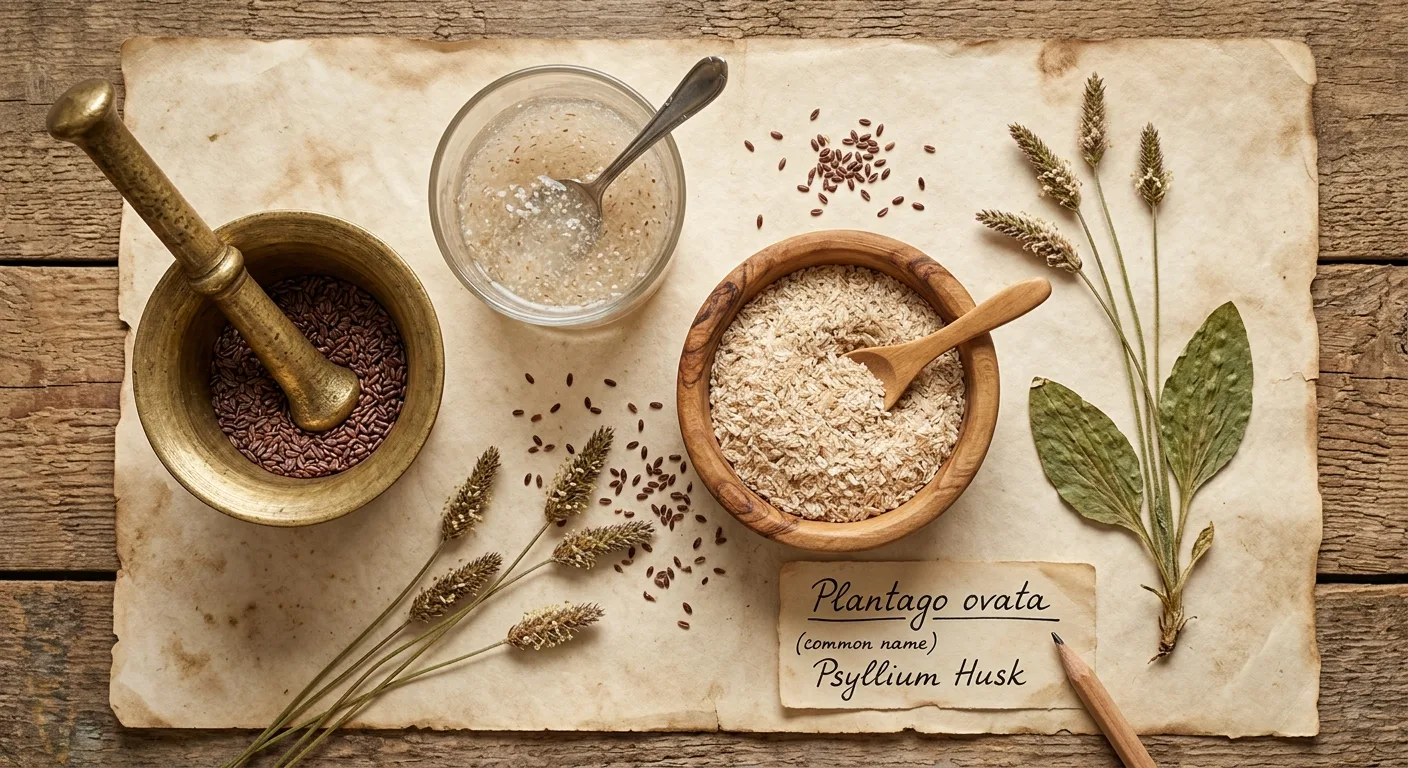
Psyllium husk is the outer coating — the seed coat or husk — of the seeds of Plantago ovata, a small, unassuming annual herb in the Plantaginaceae family, the same family as the common plantain weeds found across European meadows and roadsides. Unlike its European cousins, Plantago ovata is native to the arid and semi-arid regions of the Indian subcontinent and the Middle East. It is a low-growing plant, typically reaching only 30 to 45 centimetres in height, with narrow, linear leaves and small, unremarkable flower spikes. The plant itself is botanically modest — the remarkable part is what happens when its seed husk meets water.
The seeds of Plantago ovata are tiny — each one roughly 2 to 3 millimetres long — and light tan to pinkish-brown in colour. Each seed is encased in a translucent, paper-thin husk that constitutes approximately 25 to 30 percent of the seed by weight. It is this husk, not the seed interior, that is the commercially valuable part. When separated from the seed and ground into a powder or left as coarse flakes, psyllium husk becomes one of the most concentrated natural sources of soluble dietary fibre known. The husk contains roughly 70 to 80 percent soluble fibre by dry weight — a remarkably high concentration compared to other common fibre sources such as oat bran (about 5 percent) or flaxseed (roughly 25 percent).
The name 'psyllium' derives from the Greek word psylla, meaning flea, a reference to the tiny, flea-shaped seeds. In Indian and Unani traditional medicine it is known as isabgol or ispaghula, from the Persian words asp and ghol, roughly meaning 'horse ear' — describing the shape of the seed. Today, psyllium husk is one of the most widely used natural fibre ingredients in the world, found not only in dietary supplements but also in breakfast cereals, gluten-free baking, and a range of food-industry applications where its gel-forming property is valued.
Where does psyllium grow?
Plantago ovata is native to the arid plains and semi-desert regions of the Indian subcontinent, the Iranian plateau, and parts of the Arabian Peninsula. It thrives in dry, sandy soils with minimal rainfall — conditions that would stress most crop plants but suit Plantago ovata well. The plant has evolved to produce its fibre-rich husk as a survival mechanism: when the brief rains come, the husk absorbs and holds water around the germinating seed, giving the next generation a brief but crucial moisture reserve in an otherwise parched landscape.
India is by far the world's largest producer and exporter of psyllium husk. The state of Gujarat, particularly the Mehsana and Banaskantha districts in its northern part, accounts for the majority of global production. Rajasthan and Madhya Pradesh are also significant growing regions. Indian psyllium cultivation is concentrated during the rabi (winter) season, with planting in October or November and harvest in February or March. The cool, dry winters of Gujarat provide ideal conditions — the plant needs minimal water and performs best when the weather stays dry during seed maturation.
Outside India, psyllium is grown commercially in Pakistan, primarily in the Balochistan and Sindh provinces, and to a lesser extent in parts of Iran, Spain, France, and the southern United States. However, Indian production dominates the global supply chain — India produces an estimated 80 to 90 percent of the world's commercial psyllium crop. The processing infrastructure is also concentrated in India, with Gujarat hosting the largest milling and export facilities for psyllium husk and psyllium husk powder.
History and traditional use
Psyllium's documented history in human use stretches back over two thousand years, rooted firmly in the Ayurvedic medical tradition of the Indian subcontinent. In classical Ayurvedic texts, isabgol is described as a cooling, soothing substance used to balance certain digestive conditions. It appears in the Charaka Samhita and the Sushruta Samhita, two foundational texts of Ayurvedic medicine composed between roughly 600 BCE and 200 CE. The traditional preparation was straightforward: psyllium husks soaked in water until they formed a gel, then consumed. This remarkably simple approach — relying on the physical property of the husk rather than any extracted compound — has remained essentially unchanged for millennia.
The Unani (Greco-Arab) medical tradition, which developed from Greek and Persian medical knowledge and flourished across the Islamic world from the 8th century onwards, also adopted isabgol as a standard remedy. Unani practitioners valued psyllium for its mucilaginous character and its classification as a 'cold and moist' substance in their humoral system. Through the Unani tradition, knowledge of psyllium spread across the Middle East, Central Asia, and North Africa, well before it reached European awareness.
In Europe, awareness of psyllium grew gradually through contact with Middle Eastern and Indian herbal knowledge. By the 19th century, European pharmacopoeias had begun to include Plantago ovata seed preparations. In the 20th century, psyllium husk became a mainstream ingredient in Western health products, initially popularised in the United States through bulk fibre laxative brands in the 1930s and 1940s. By the late 20th century, psyllium was one of the most studied dietary fibres in the world, with research interest driven by its unusual physical properties and its long history of safe traditional use.
Phytochemistry: what makes psyllium husk unique
The defining feature of psyllium husk is not a single active compound in the pharmaceutical sense, but rather a physical property: its extraordinary capacity to absorb water. This property comes from arabinoxylan, a branched-chain soluble polysaccharide that makes up approximately 60 to 70 percent of the husk's dry weight. Arabinoxylan is a type of hemicellulose — a complex carbohydrate built from a backbone of xylose sugar units with arabinose branches attached at regular intervals along the chain. When psyllium husk meets water, the arabinoxylan chains hydrate rapidly, absorbing many times their own weight in water and swelling to form a viscous, gel-like mass.
This water-absorption capacity is genuinely dramatic. A single gram of psyllium husk can absorb and hold many times its own weight in water — forming a soft, slippery gel that is quite unlike the behaviour of most other dietary fibres. Oat bran, wheat bran, and cellulose-based fibres absorb some water, but they do not form the same kind of cohesive, viscous gel. This gel-forming property is the foundation of all traditional and modern uses of psyllium husk. It is a physical mechanism, not a biochemical one — the husk works through its interaction with water, not through any drug-like effect on the body's chemistry.
Beyond arabinoxylan, psyllium husk contains smaller amounts of other polysaccharides including rhamnose and galacturonic acid residues, as well as trace amounts of lipids, proteins, and minerals. However, these minor components are not considered significant to the husk's traditional use — it is the arabinoxylan gel-forming property that drives nearly all applications. The seed itself (the kernel inside the husk) has a different composition, being richer in proteins and fats, but it is the husk that is separated and used commercially.
How psyllium husk is used today
Psyllium husk is used today across three broad domains: dietary supplements, food manufacturing, and traditional herbal practice. In the supplement industry, psyllium husk is available as whole husk, husk powder, and in capsule form. Doses in commercial supplements vary widely, from as little as 50mg in multi-ingredient digestive formulas up to several grams per serving in standalone fibre products. The traditional recommended approach is to take psyllium husk with a generous amount of water, as the husk's gel-forming action depends on adequate hydration.
In the food industry, psyllium husk powder is valued as a natural thickener, emulsifier, and binding agent. It is particularly important in gluten-free baking, where it can partially replicate the elastic, binding properties of gluten in bread and pastry doughs. Psyllium is also used in ice cream, sauces, and various processed foods where a smooth, gel-like texture is desired. The food-industry applications exploit the same physical property that makes psyllium useful in supplements — its ability to absorb water and form a cohesive gel.
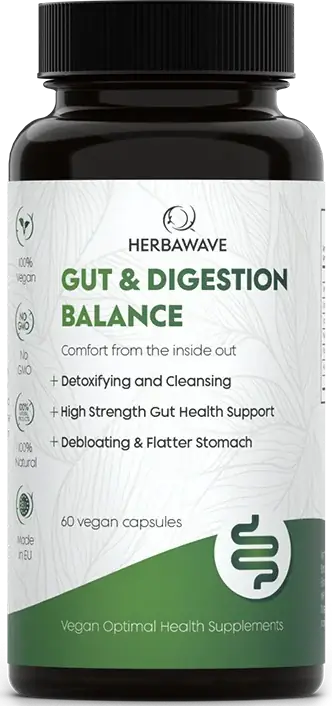
In the Gut & Digestion Balance formula by HerbaWave, psyllium husk is included at 50mg per capsule as part of the second phase — the bulk-forming and soothing phase. At this dose it works alongside flaxseed and aloe vera gel powder, contributing its gel-forming soluble fibre to a multi-ingredient digestive formula rather than serving as a standalone high-dose fibre product. This approach reflects the traditional Ayurvedic principle of combining complementary ingredients rather than relying on any single botanical at maximum dose.
Safety and considerations
Psyllium husk has a long history of safe use in human diets and is generally well tolerated. It has been consumed as a food and supplement ingredient for over two thousand years across multiple cultural traditions. The most commonly reported side effects are mild and related to the fibre's physical action: temporary bloating, gas, or a feeling of fullness, particularly when psyllium is introduced too quickly without adequate water intake. These effects typically resolve as the body adjusts to the increased fibre intake, and they can be minimised by starting with a small amount and gradually increasing the dose while drinking plenty of water.
The most important practical safety point with psyllium husk is adequate water intake. Because the husk absorbs many times its weight in water, taking psyllium with insufficient liquid — particularly in dry powder or capsule form — can theoretically lead to the material swelling in the oesophagus or throat before reaching the stomach. This risk is essentially eliminated by taking psyllium with a full glass of water, which is the standard recommendation for any psyllium-containing product.
Psyllium husk can theoretically affect the absorption timing of certain oral medications if taken at the same time, because the gel it forms in the digestive tract may slow the passage of other substances. For this reason, the standard recommendation is to take psyllium at least one to two hours before or after any prescription medication. People with known narrowing of the digestive tract, difficulty swallowing, or any existing gastrointestinal condition should consult their doctor before taking psyllium supplements. As with all herbal and dietary supplements, anyone who is pregnant, breastfeeding, or taking prescription medication should seek medical advice before starting a new supplement.
Frequently asked questions
What is psyllium husk made of? ▾
Psyllium husk is the outer seed coat of Plantago ovata, a small annual herb. The husk is composed primarily of arabinoxylan, a soluble polysaccharide that makes up roughly 70 to 80 percent of its dry weight. This high concentration of soluble fibre is what gives psyllium husk its distinctive gel-forming property when mixed with water.
How much water does psyllium husk absorb? ▾
A single gram of psyllium husk can absorb many times its own weight in water, forming a soft, viscous gel. This dramatic water-absorption capacity is significantly higher than most other common dietary fibres. The exact ratio depends on conditions such as temperature, pH and the type of liquid, but the gel-forming capacity is consistently remarkable — it is this physical property that underpins all of psyllium's traditional and modern uses.
Where does psyllium husk come from? ▾
Psyllium husk comes from Plantago ovata, a plant native to the Indian subcontinent and the Middle East. India, particularly the state of Gujarat, is the world's largest producer, accounting for an estimated 80 to 90 percent of global commercial production. The plant is cultivated during the cool, dry winter season and harvested in early spring.
Should I take psyllium husk with water? ▾
Yes — taking psyllium husk with a generous amount of water is the standard and most important recommendation. Because the husk absorbs many times its weight in water, adequate hydration ensures it forms its characteristic gel in the stomach rather than swelling prematurely. A full glass of water (at least 250ml) per serving is the typical guidance for any psyllium-containing product.
Is psyllium husk the same as psyllium powder? ▾
They are the same material in different physical forms. Psyllium husk refers to the whole, coarse flakes of the seed coat as it is separated from the seed. Psyllium husk powder is simply those same flakes ground to a finer consistency. Both contain the same arabinoxylan soluble fibre and have the same gel-forming properties — the powder dissolves more quickly in water, while the whole husk has a slightly coarser texture.
Does psyllium husk have any EFSA-approved health claims? ▾
In the context of dietary supplements, there is no specific EFSA-approved health claim for psyllium husk. Plantago ovata is treated as a traditionally-used botanical under EU supplement regulation. Its long history of safe use is well-documented, but the EU regulatory framework requires modern clinical trial data for specific health claims, and no such claim has been approved for psyllium in the supplement context. Some food products containing psyllium may carry approved fibre-related claims, but these apply to the food product category rather than to supplement dosage forms.
Can I take psyllium husk with medication? ▾
Psyllium husk can theoretically affect the absorption timing of oral medications because the gel it forms may slow the passage of other substances through the digestive tract. The standard recommendation is to take psyllium at least one to two hours before or after any prescription medication. Anyone taking prescription drugs should consult their doctor before starting a psyllium supplement.
How long has psyllium been used in traditional medicine? ▾
Psyllium has been used in Ayurvedic medicine on the Indian subcontinent for over two thousand years. It appears in the Charaka Samhita and the Sushruta Samhita, two of the foundational texts of Ayurvedic medicine composed between roughly 600 BCE and 200 CE. The Unani (Greco-Arab) medical tradition also adopted psyllium, spreading knowledge of it across the Middle East and Central Asia from the 8th century onwards.