Ingredient reference
Senna Leaf
Senna alexandrina · Fabaceae
Native range
Egypt, Sudan, Arabian peninsula; commercially cultivated in India
Part used
Leaves (and pods)
Key compounds
Sennoside A, Sennoside B, Sennoside C, Sennoside D
Traditional use
Used in Arabic and European herbalism since the 9th century for intestinal motility support
What is senna leaf?
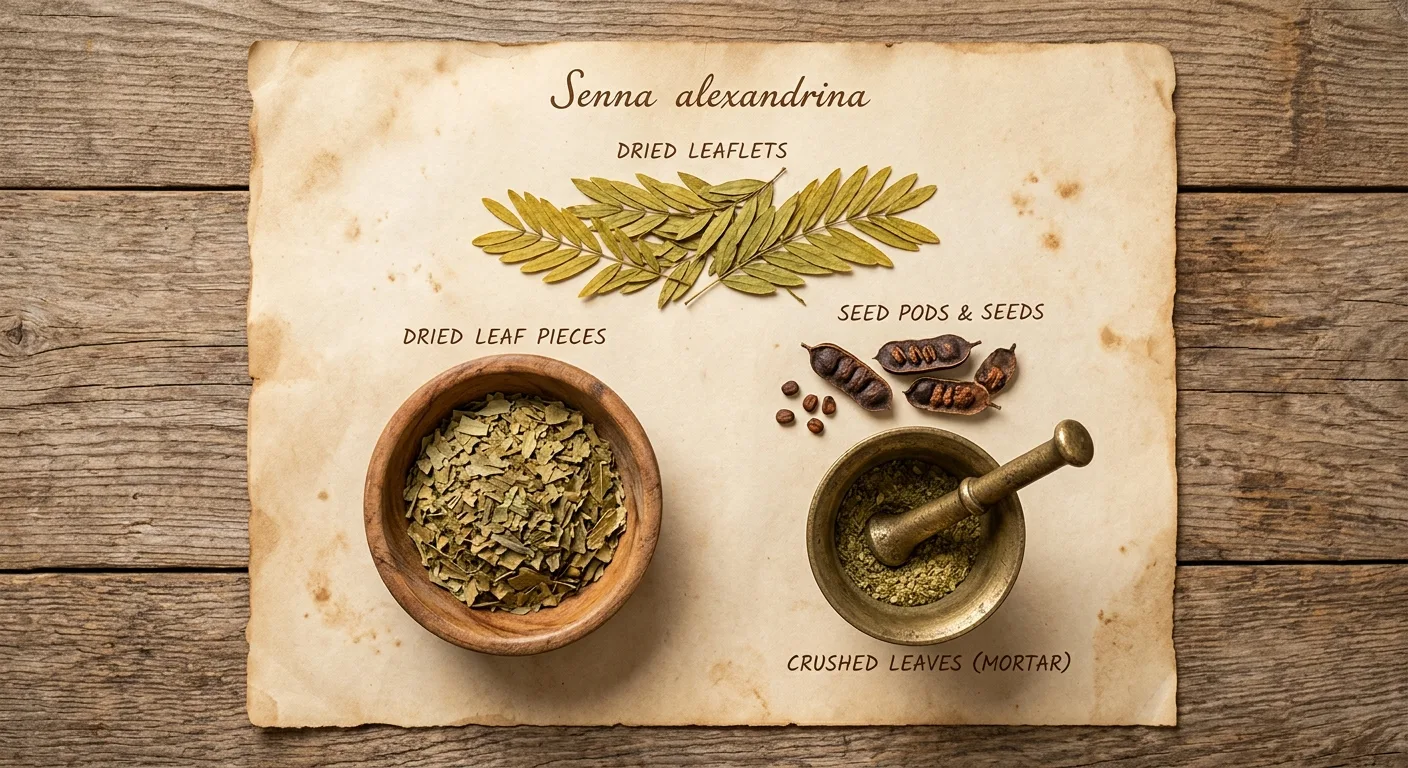
Senna leaf comes from Senna alexandrina (syn. Cassia angustifolia, Cassia senna), a small, drought-tolerant shrub of the Fabaceae family — the legume family, the same vast plant family as chickpeas, lentils and liquorice root. The plant grows to roughly one metre in height and produces pinnately compound leaves with four to eight pairs of narrow, lance-shaped leaflets. In late summer, clusters of yellow, five-petalled flowers give way to flat, papery seed pods. Both the leaves and the pods contain the bioactive compounds for which senna has been valued in herbal medicine for over a thousand years, though the leaves are the primary part used in European supplement traditions.
The English common name 'senna' derives from the Arabic word sana, which is the name the plant carries in the Arabic medical texts that first brought it to widespread European attention. The species name alexandrina refers to the Egyptian port city of Alexandria, through which dried senna leaves were shipped from Egypt and Sudan to medieval European markets. A second commercial variety, known as Tinnevelly senna (Cassia angustifolia), is cultivated in the Tamil Nadu region of southern India — modern botanical taxonomy considers them the same species, Senna alexandrina, though the trade still distinguishes 'Alexandrian' (North African) and 'Tinnevelly' (Indian) grades.
Senna is one of the most widely recognised stimulant herbs in the world and holds a unique position in the history of European herbal medicine: it is not a native European plant, but was introduced to the European pharmacopoeia through the Arabic medical tradition during the 9th and 10th centuries — making it one of the earliest examples of cross-cultural botanical knowledge transfer between the Arab world and medieval Europe. Today, senna leaf remains listed in the European Pharmacopoeia and is one of the best-characterised traditional botanicals in terms of its phytochemistry.
Where does senna grow?
The original wild habitat of Senna alexandrina is the arid and semi-arid scrubland of North Africa and the Middle East. The plant is native to the upper Nile Valley of Egypt and Sudan, extending eastward across the Red Sea coast of the Arabian peninsula into parts of modern-day Yemen and Oman. It thrives in sandy, well-drained soils under full sun with minimal rainfall — a characteristic desert legume adapted to some of the driest inhabited regions on Earth.
Although wild senna still grows across its native range, the vast majority of commercial senna leaf today comes from cultivated plantations in India, particularly the Tirunelveli district of Tamil Nadu and the Jodhpur region of Rajasthan. India has been the dominant commercial producer since the 19th century, when British colonial botanists systematised the cultivation of Cassia angustifolia (now recognised as the same species) for export to European pharmaceutical markets. Smaller quantities are still harvested in Sudan and Egypt, and some cultivation occurs in Pakistan and parts of East Africa.
A thousand years from Arabic medicine to European herbalism
Senna occupies a distinctive place in European herbal history because it arrived not from the Graeco-Roman medical tradition — unlike most European medicinal herbs — but from Arabic medicine. The earliest known written references to senna as a medicinal plant appear in the works of 9th-century Arab physicians, including the influential texts of Ishaq ibn Imran and later the Persian polymath Avicenna (Ibn Sina), who recommended it in his Canon of Medicine (completed around 1025 AD). Arab physicians valued senna highly and described its use with considerable specificity and caution.
The plant entered European herbalism during the great wave of Arabic-to-Latin medical translations in the 11th and 12th centuries, particularly through the work of Constantinus Africanus at the Salerno medical school in southern Italy. By the 13th century, senna was a standard item in European apothecary inventories and appeared in the formularies of Salernitanum medical texts. The trade route was well established: dried senna leaves were shipped from Egypt and Sudan to the port of Alexandria, then carried by Venetian and Genoese merchants to Europe — hence the trade name 'Alexandrian senna' that persists in botanical nomenclature to this day.
By the Renaissance, senna was firmly established in European herbals. It appears in the Pharmacopoeia Londinensis of 1618, the first official pharmacopoeia of the Royal College of Physicians, and in the French Pharmacopee of the same era. European herbalists adopted not only the plant but also many of the Arabic guidelines for its use — including the recommendation that it be used for short courses rather than continuously, a principle that has remained remarkably consistent from the medieval Arabic texts through to modern European herbal practice.
Phytochemistry: the sennoside compounds
The bioactive compounds in senna leaf belong to a class of phytochemicals called anthraquinone glycosides — specifically, the sennosides. The four primary sennosides are designated A, B, C and D. Sennosides A and B are the most abundant and are considered the principal active constituents; they are dianthrone glycosides, meaning they consist of two anthraquinone units linked together with sugar molecules attached. Sennosides C and D are present in smaller quantities and are structurally related but have slightly different chemical architectures.
The sennosides are prodrugs — they are not directly active in their ingested form. After oral ingestion, the sennosides pass through the stomach and small intestine largely intact because they are resistant to hydrolysis by mammalian digestive enzymes. It is only when they reach the large intestine that the resident gut bacteria (particularly species of Bifidobacterium and Eubacterium) cleave the sugar bonds, releasing the active aglycone form called rhein anthrone. This bacterial metabolism step is why senna has a delayed onset of action compared to some other botanical preparations — it takes time for the compounds to transit through the upper digestive tract and then be metabolised by colonic bacteria.
The total sennoside content of dried senna leaf typically ranges from 2% to 5% by weight, depending on the growing region, harvest timing and post-harvest processing. Pharmacopoeial monographs generally specify a minimum sennoside content (calculated as sennoside B) for pharmaceutical-grade material. Beyond the sennosides, senna leaf also contains smaller amounts of free anthraquinones (rhein, aloe-emodin), flavonoids (kaempferol and isorhamnetin glycosides), mucilage, and traces of volatile oils — but the sennosides are overwhelmingly the most significant compounds from a traditional-use perspective.
How is senna used today?
Senna leaf remains one of the most widely used traditional botanicals in European and global herbal practice. It is available as a single-ingredient herbal tea, as a dried leaf powder in capsules, and as a standardised extract. The European Pharmacopoeia includes monographs for both senna leaf (Sennae folium) and senna pods (Sennae fructus), reflecting its continued recognition as a pharmacopoeial botanical. In many European countries, senna-based preparations are available both as traditional herbal products and as over-the-counter items in pharmacies.
In combination formulas — such as Gut & Digestion Balance, which contains 500mg of senna leaf per serving — senna is typically paired with complementary botanicals. Common traditional pairings include fibre-rich herbs like psyllium husk (which adds bulk), soothing botanicals like aloe vera gel, and other anthranoid herbs like cascara sagrada bark. The rationale for combination formulas in the herbal tradition is that a multi-ingredient approach can be gentler and more balanced than a high dose of any single stimulant botanical used alone.
Safety, contraindications and responsible use
Senna is a stimulant botanical and carries important safety considerations that distinguish it from milder herbal preparations. The single most important principle — consistent from the medieval Arabic texts through to modern European herbal guidance — is that senna is intended for short-term use only. It is not a daily tonic herb; it is a specific-purpose botanical traditionally used for brief courses. Most European herbal authorities recommend use for no longer than one to two weeks at a time without professional guidance.
Senna is contraindicated during pregnancy and breastfeeding. It should not be used by individuals with inflammatory bowel conditions, intestinal obstruction, or undiagnosed abdominal pain. People taking prescription medications — particularly cardiac glycosides, diuretics, corticosteroids, or medications that affect electrolyte balance — should consult their doctor before using senna, because prolonged or excessive use can theoretically affect potassium levels. Children under 12 should not take senna-containing supplements unless directed by a healthcare professional.
There is no specific EFSA-approved health claim for Senna alexandrina. Like many traditional botanicals, senna is treated as a traditionally-used plant in EU supplement regulation. Its historical use spanning over a thousand years is extensively documented, but the EU regulatory framework for health claims requires modern randomised clinical trial data, and senna has not yet received an approved health claim through this process. This does not diminish senna's long documented history of traditional use — it simply reflects the current state of the EU claims evaluation process, which has a large backlog of botanical applications still under review.
Frequently asked questions
Is senna leaf safe for daily use? ▾
No. Senna is a stimulant botanical and is not intended for continuous daily use. Both the traditional Arabic medical texts and modern European herbal guidance agree that senna should be used for short courses only — typically no longer than one to two weeks at a time. If you feel you need ongoing support, consult a doctor or qualified herbalist rather than using senna continuously.
Can I take senna during pregnancy? ▾
No. Senna is traditionally contraindicated during pregnancy and breastfeeding. This is a long-standing safety guideline that has been consistent across Arabic and European herbal traditions for centuries. If you are pregnant, breastfeeding or planning to become pregnant, do not take senna-containing supplements and consult your doctor for alternatives.
What dose of senna leaf is typical in supplements? ▾
European supplement formulas typically use between 200mg and 500mg of senna leaf per serving. Gut & Digestion Balance contains 500mg per serving, which is at the upper end of standard European supplemental doses. The appropriate dose depends on the specific product formulation — always follow the dosage recommendations on the label. If you are new to senna-containing supplements, many herbalists recommend starting with half the full dose for the first few days.
Where does the name 'Alexandrian senna' come from? ▾
The name refers to the Egyptian port city of Alexandria, which was the main hub through which dried senna leaves from Egypt and Sudan were shipped to medieval European markets. The botanical species name alexandrina also records this trade connection. A second trade name, 'Tinnevelly senna', refers to the Tirunelveli district in Tamil Nadu, India, where senna has been cultivated commercially since the colonial era. Modern taxonomy considers both varieties the same species.
What is the difference between senna leaf and senna pods? ▾
Both senna leaves and pods (the flat seed cases) contain sennosides, but they differ in potency and traditional use. Senna pods are generally considered milder because they contain a lower concentration of sennosides by weight. The European Pharmacopoeia includes monographs for both — Sennae folium (leaf) and Sennae fructus (pod) — reflecting their distinct profiles. In supplement formulas, the leaf form is more common because it provides a more consistent and higher sennoside content per unit weight.
Can I take senna alongside prescription medications? ▾
You should consult your doctor before taking senna if you are on any prescription medication. Senna can theoretically interact with medications that are sensitive to changes in potassium levels — including cardiac glycosides (such as digoxin), certain diuretics, and corticosteroids. The risk is primarily relevant to prolonged or excessive use rather than short-term use at recommended doses, but medical guidance is always advisable when combining herbal supplements with prescription drugs.
Does senna leaf have any EFSA-approved health claims? ▾
No specific EFSA-approved health claim currently exists for Senna alexandrina. It is treated as a traditionally-used botanical in EU supplement regulation — its extensive historical use is well documented, but the EU regulatory framework requires modern clinical trial data for specific health claims. This is the same status as many other traditional botanicals whose claim applications are still in the EU evaluation pipeline.
How long does it take for senna to work? ▾
Senna has a characteristically delayed onset because its active compounds (sennosides) are prodrugs that must reach the large intestine before being activated by gut bacteria. This transit and activation process typically takes 6 to 12 hours from ingestion, which is why many people find it most practical to take senna-containing supplements in the evening. The exact timing varies between individuals depending on gut transit time and microbiome composition.