Ingredient reference
Burdock Root
Arctium lappa · Asteraceae
Native range
Throughout Europe and temperate Asia, including Bulgaria
Part used
Root
Key compounds
Inulin, Chlorogenic acid, Caffeic acid, Arctiopicrin, Arctiin (lignan)
Traditional use
Used in European herbalism as a 'blood purifier' and digestive bitter since at least the medieval period
What is burdock root?
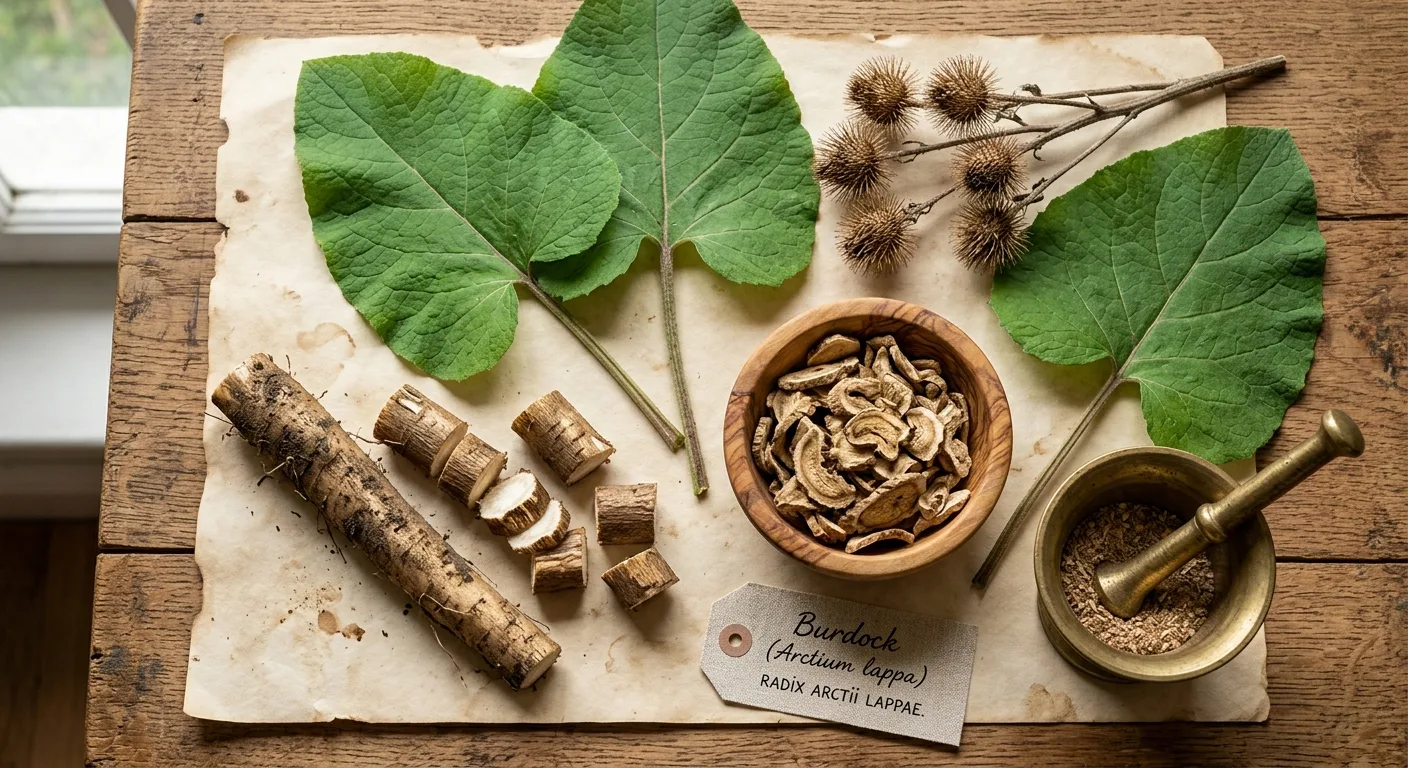
Burdock (Arctium lappa) is a tall, robust biennial plant of the Asteraceae family — the same family as daisies, dandelions, artichokes and milk thistle. It grows to a height of one to two metres in its second year, producing broad, heart-shaped basal leaves that can span half a metre across and a stout, branching stem topped with clusters of small purple-pink flower heads. The flower heads mature into the famous burs — spiny, hooked seed cases that attach themselves tenaciously to clothing, animal fur and hair. Anyone who has walked through European countryside in late summer or autumn has almost certainly encountered burdock burs clinging to socks and trouser legs.
It is the burs, in fact, that gave burdock its place in invention history. In 1941, the Swiss engineer George de Mestral returned from a walk in the Jura mountains and noticed burdock burs clinging to his trousers and his dog's fur. Curious about the mechanism, he examined a bur under a microscope and found that each spine ended in a tiny hook that caught on the loops of fabric or fur. It took him nearly a decade of experimentation, but de Mestral eventually patented a two-strip fastening system based on that hook-and-loop principle — and named it Velcro, from the French words velours (velvet) and crochet (hook). Burdock, quite literally, inspired one of the most ubiquitous fastening technologies of the 20th century.
Despite the fame of its burs, however, the part of the plant prized in European herbal tradition is the root. Burdock root is a long, slender taproot — brown and fibrous on the outside, white and slightly sweet on the inside — that can grow up to a metre deep in loose soils. It is harvested in the first autumn or the second spring, before the plant sends up its flowering stalk, because at that point the root contains its maximum concentration of stored nutrients and active compounds. Once the plant flowers in its second summer, the root becomes woody and largely spent, having channelled its reserves into producing the tall stalk, flowers and ultimately the famous burs.
Where does burdock grow?
Arctium lappa is native to the temperate regions of Europe and Asia. Unlike many medicinal herbs that prefer warm, dry Mediterranean climates, burdock thrives in cool, moist conditions and is found from the British Isles and Scandinavia all the way through Central and Eastern Europe, the Balkans, Russia, the Caucasus, Central Asia, China and Japan. It is a plant of moderate shade and nutrient-rich soils — forest edges, riverbanks, hedgerows, roadsides, field margins, waste ground, old farmyards and any piece of disturbed, nitrogen-rich earth. Its preference for disturbed ground makes it a classic 'ruderal' species, one of the first to colonise abandoned or cleared land.
In Bulgaria, burdock grows wild across the entire country — in the lowlands around the Danube plain, in the foothill regions of the Rhodopes and Stara Planina, and in the transition zones between cultivated land and forest. It is particularly abundant along forest edges and streams in the lower mountain regions, where the soil is rich and moist. The Bulgarian common name for burdock is 'репей' (repey), and the plant has been collected by village herbalists for generations. In Bulgarian folk practice, the root was traditionally dug up in late autumn after the first frosts, or in early spring before the plant began to grow its second-year stalk. The timing matters because the root is at its densest and most nutrient-rich during the dormant period between growing seasons.
Burdock has also been deliberately cultivated for culinary use, particularly in Japan, where it is known as gobo and is a staple root vegetable. Japanese cultivars have been bred for longer, straighter, less fibrous roots that are easier to cook with. Burdock root appears in many traditional Japanese dishes — kinpira gobo (stir-fried burdock), takikomi gohan (mixed rice), and as a component of traditional New Year foods. In Europe, burdock root was historically used to brew a traditional soft drink called 'dandelion and burdock', which originated in England and remains available today in some form across the British Isles.
History and traditional use
Burdock root has been used in European herbalism for centuries, though its documented history is not as ancient as some Mediterranean herbs. The earliest clear European references to burdock as a medicinal plant date from the medieval period, when it appeared in several important herbals. Hildegard von Bingen, the 12th-century German Benedictine abbess and herbalist, mentioned burdock in her writings on natural remedies. By the Renaissance, burdock root was well established in the European materia medica, appearing in the herbal compilations of Leonhart Fuchs, John Gerard and Nicholas Culpeper.
The traditional role of burdock root in European herbalism was primarily as a 'blood purifier' — a term that predates modern understanding of physiology but which in practice referred to herbs used to support the body's natural cleansing processes, improve skin appearance and promote general vitality. Burdock root was commonly prepared as a decoction (boiled extract) or tincture and was included in many compound formulas alongside other 'alterative' herbs such as dandelion, yellow dock, red clover and nettle. The bitter taste of the root was considered important in itself — European herbal tradition holds that bitter-tasting herbs stimulate digestive secretions and help the body process food more efficiently, a concept that modern research into bitter taste receptors has begun to explore.
In traditional Chinese medicine, burdock seed (niubangzi) has its own distinct history, used for conditions related to wind-heat patterns — sore throat, skin eruptions and respiratory complaints. Japanese kampo medicine uses both the root and seed. The cross-cultural breadth of burdock's traditional use — spanning European, Chinese and Japanese herbal systems — is notable, as not all plants have found independent recognition across such geographically distant traditions.
Phytochemistry: what does burdock root contain?
The single most abundant compound in burdock root is inulin, a fructo-oligosaccharide that can constitute up to 50% of the dried root weight. Inulin is a soluble dietary fibre that passes through the human small intestine undigested and arrives in the colon, where it serves as a substrate for beneficial gut bacteria — the reason it is classified as a prebiotic. The high inulin content explains burdock root's mildly sweet taste when fresh and its traditional reputation as a nourishing food-medicine. Inulin is not unique to burdock — it also occurs in chicory, dandelion, Jerusalem artichoke and garlic — but few herbs contain it in such high concentrations.
Beyond inulin, burdock root contains a range of polyphenolic compounds. The most prominent are chlorogenic acid and caffeic acid, both members of the hydroxycinnamic acid family that are widespread in the plant kingdom and are known antioxidants. Burdock root also contains small quantities of other phenolic acids, flavonoids and tannins. The overall polyphenol profile is not as concentrated or as pharmacologically distinctive as the silymarin complex in milk thistle, for example, but it contributes to the broad antioxidant capacity that characterises many traditional 'alterative' herbs.
Two compound classes give burdock root its distinctive character. The first is arctiopicrin, a sesquiterpene lactone responsible for the bitter taste of the root. Sesquiterpene lactones are common across the Asteraceae family — they also occur in dandelion, artichoke and chamomile — and are the chemical basis for the 'bitter tonic' reputation of many traditional digestive herbs. The second is the lignans, particularly arctiin and its aglycone arctigenin. Lignans are a class of polyphenols found widely in seeds, grains and roots. Arctiin and arctigenin have attracted research interest for their antioxidant properties, though as with many plant lignans, the clinical evidence in humans remains preliminary.
How is burdock root used today?
In the modern European supplement market, burdock root appears most commonly as one ingredient within multi-herb formulas, particularly those designed around the traditional concept of liver and digestive support. It is frequently combined with milk thistle, dandelion, artichoke and other 'bitter' herbs — a combination that mirrors centuries of European herbal practice. Standalone burdock root supplements also exist, typically as dried root capsules, root extract capsules, or liquid tinctures, though they are less common than the multi-herb formulas.
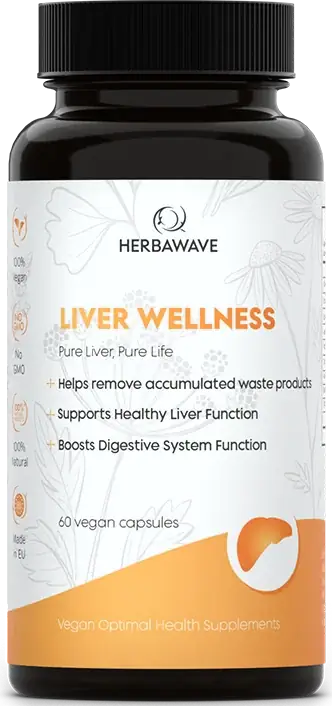
HerbaWave Liver Wellness contains 150mg of burdock root extract per serving as part of its four-botanical formula alongside milk thistle (400mg), dandelion (200mg) and artichoke leaf (150mg). The inclusion of burdock root reflects the traditional European practice of combining bitter herbs: the arctiopicrin in burdock, the cynarin in artichoke and the sesquiterpene lactones in dandelion each represent a different class of plant-derived bitter compounds, while milk thistle contributes the silymarin flavonolignan complex. The formula is designed around the traditional synergy of these four herbs as they have been used together in European herbalism for generations.
Safety and considerations
Burdock root has a long history of safe use both as a food and as a herbal preparation. In Japan, it is consumed daily as a vegetable without any special safety concern. In the European supplement context, burdock root at typical extract doses (100-500mg per day) is generally well tolerated. There are no widespread reports of serious adverse effects at normal dietary supplement doses.
People with known allergies to plants in the Asteraceae family (daisies, ragweed, chrysanthemums, marigolds) should exercise caution with burdock, as cross-reactivity is theoretically possible. Burdock root's high inulin content means that people who are sensitive to inulin or fructo-oligosaccharides may experience digestive discomfort (bloating, gas) at higher doses — this is a common characteristic of high-inulin foods, not specific to burdock. Pregnant or breastfeeding women are generally advised to consult a healthcare professional before using burdock root supplements, as there is insufficient safety data for these populations. Anyone taking prescription medication, particularly blood sugar-lowering drugs, should also consult a healthcare professional, as some animal studies have observed effects on blood sugar levels.
Frequently asked questions
What are the main active compounds in burdock root? ▾
Burdock root contains inulin (up to 50% of dry weight), polyphenols (chlorogenic acid, caffeic acid), the bitter sesquiterpene lactone arctiopicrin, and lignans (particularly arctiin and arctigenin). The high inulin content is the most distinctive nutritional feature, while arctiopicrin provides the bitter taste that European herbalists traditionally valued.
Is burdock root safe to take as a supplement? ▾
Burdock root has a long history of safe use as both a food and a herbal preparation. In Japan it is eaten daily as a vegetable. At typical supplement doses (100-500mg per day), it is generally well tolerated. People with Asteraceae allergies should exercise caution, and pregnant or breastfeeding women should consult a healthcare professional before use.
Does burdock root have any EFSA-approved health claims? ▾
No. There is currently no specific EFSA-approved health claim for Arctium lappa (burdock root). It is treated as a traditionally-used botanical in EU supplement regulation. Many products containing burdock root carry EFSA claims for other ingredients in the formula.
How did burdock inspire the invention of Velcro? ▾
In 1941, Swiss engineer George de Mestral returned from a walk in the Jura mountains and noticed burdock burs clinging to his trousers and his dog's fur. Under a microscope, he discovered that each bur spine ended in a tiny hook that caught on fabric loops. After nearly a decade of experimentation, he patented a two-strip fastening system based on this hook-and-loop principle and named it Velcro, from the French words velours (velvet) and crochet (hook).
What is the difference between burdock root and dandelion root? ▾
Both are Asteraceae-family roots used in European herbalism as 'bitter' herbs, but they contain different compound profiles. Burdock root is rich in inulin (up to 50% dry weight), arctiopicrin and lignans. Dandelion root contains sesquiterpene lactones, taraxacin, inulin (though less than burdock), and various polyphenols. They are traditionally considered complementary, which is why both appear in many European digestive herb formulas, including HerbaWave Liver Wellness.
Why is burdock root combined with milk thistle in supplements? ▾
Burdock root and milk thistle have been used together in European herbal formulas for generations. They complement each other: milk thistle contributes the silymarin complex of flavonolignans, while burdock root contributes inulin, polyphenols and the bitter compound arctiopicrin. The tradition of combining multiple bitter and supportive herbs in a single formula is a cornerstone of European herbal practice, and this combination is reflected in products like HerbaWave Liver Wellness.
Is burdock root the same as gobo? ▾
Yes, gobo is the Japanese name for burdock root (Arctium lappa). In Japan, burdock root is a mainstream root vegetable, cultivated specifically for culinary use. Japanese cultivars have been bred for longer, straighter, less fibrous roots. Gobo appears in many traditional Japanese dishes, including kinpira gobo (stir-fried burdock) and takikomi gohan (mixed rice). The same plant is used in both the Japanese culinary tradition and the European herbal tradition, though different cultivars may be preferred.
How much burdock root is in HerbaWave Liver Wellness? ▾
HerbaWave Liver Wellness contains 150mg of burdock root extract per serving. It is one of four botanical ingredients in the formula, alongside milk thistle (400mg), dandelion root (200mg) and artichoke leaf (150mg). The four herbs are combined according to the traditional European practice of pairing bitter and supportive botanicals together.