Ingredient reference
Artichoke
Cynara scolymus · Asteraceae
Native range
Mediterranean region, cultivated commercially in southern Bulgaria (Thracian plain)
Part used
Leaves
Key compounds
Cynarin, Chlorogenic acid, Luteolin glycosides, Sesquiterpene lactones
Traditional use
Used in Mediterranean herbalism since ancient Greek and Roman times for digestive and liver support
What is artichoke?
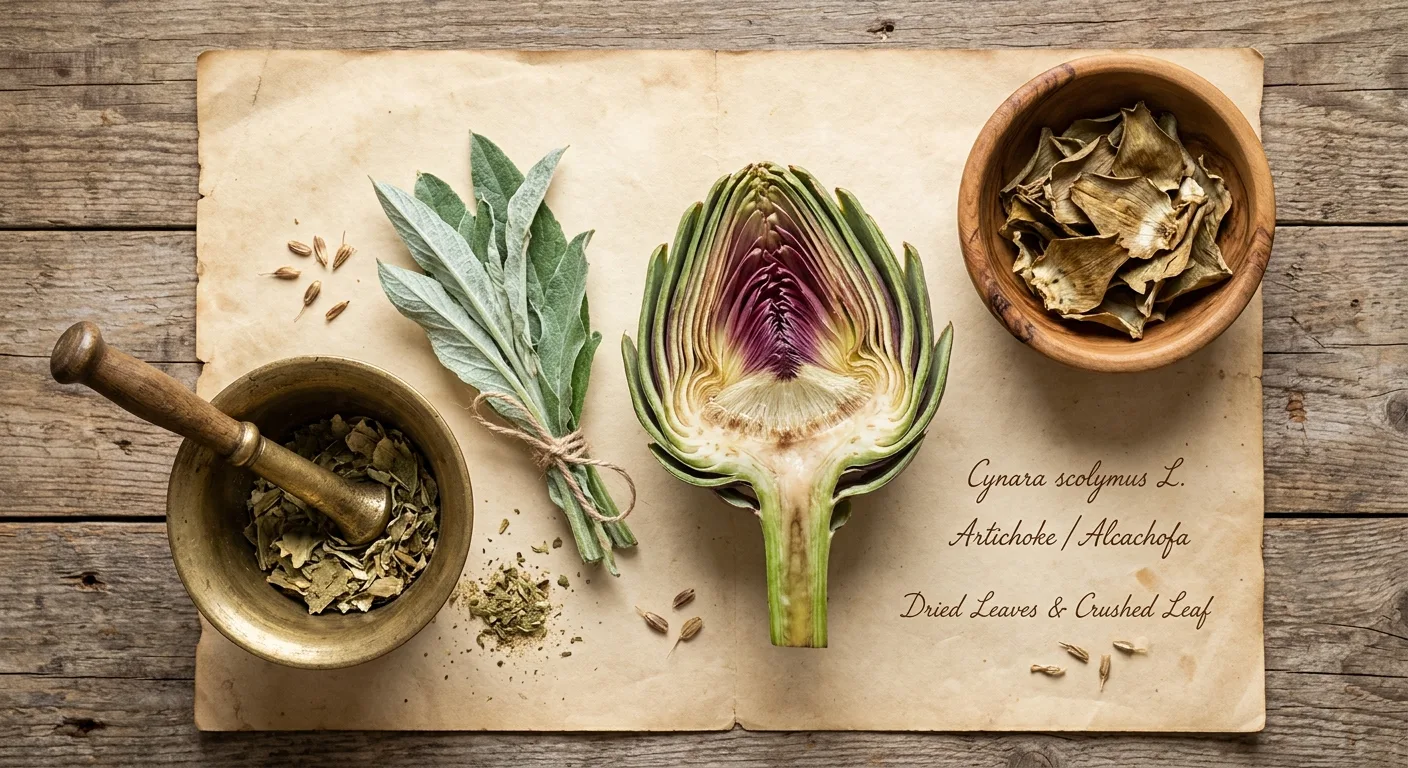
Artichoke (Cynara scolymus) is a large, thistle-like perennial plant in the Asteraceae family — the same botanical family as milk thistle, dandelion and burdock. Most people know the artichoke as a culinary vegetable: the immature flower head, or 'globe', is steamed, boiled or grilled and the fleshy bases of the bracts (the 'leaves' on a plate of artichokes) are eaten. But in European herbalism, it is the actual leaves of the plant — the large, deeply lobed, silvery-green basal leaves that grow from the stem — that have been used for centuries, not the edible flower head.
The distinction between leaf and flower head is important because the bioactive compounds that have attracted the interest of phytochemists — caffeoylquinic acids such as cynarin and chlorogenic acid, flavonoids including luteolin glycosides, and sesquiterpene lactones — are concentrated in the leaves. The flower head that arrives at the dinner table is mostly fibre and water. When a supplement label reads 'artichoke leaf extract', it specifically means an extract of the basal leaves, not the culinary globe.
Cynara scolymus is native to the Mediterranean basin and grows wild across southern Europe, North Africa and the Near East. It is a robust plant that can reach 1.5 to 2 metres in height, with a thick central stem and large, arching basal leaves that can span up to a metre in length. The familiar 'artichoke heart' is the immature flower bud; if left to bloom, it opens into a striking violet-blue thistle flower that is highly attractive to pollinators. The plant prefers warm, dry climates with well-drained soil — conditions that make the Mediterranean coast and the Thracian plain of southern Bulgaria ideal growing regions.
Where does artichoke grow?
The artichoke is native to the western and central Mediterranean — from the Iberian Peninsula through southern France, Italy, Greece, and into the coastal regions of North Africa and the eastern Mediterranean. Wild forms of Cynara (the cardoon complex) still grow across this entire range, particularly on rocky hillsides, in abandoned fields and along roadsides where the soil is dry and calcareous.
Commercial cultivation of artichoke for food is dominated by Italy, Spain, France, Egypt and Argentina. But artichoke is also cultivated for the herbal-extract industry in regions where the warm, dry climate produces leaves with a high concentration of phenolic compounds. In Bulgaria, artichoke is grown commercially in the southern Thracian plain — one of the warmest and most fertile agricultural zones in the country, situated between the Sredna Gora and Rhodope mountain ranges. The Thracian plain has a continental-Mediterranean transitional climate with hot, dry summers and mild winters, which suits the artichoke perfectly.
Bulgarian artichoke leaves are typically harvested in summer, when the phenolic content peaks, and dried at low temperatures (below 40 degrees Celsius) to preserve the cynarin, chlorogenic acid and other heat-sensitive compounds. This low-temperature drying is important because cynarin is prone to degradation at higher temperatures, and the quality of the final extract depends directly on how well the raw leaf material has been preserved.
History of artichoke in herbalism
The artichoke has one of the longest documented histories of any Mediterranean plant used in both food and traditional medicine. The ancient Greeks knew a cultivated thistle they called 'kinara' or 'cynara' — the likely origin of the modern genus name. Theophrastus mentioned it in his Enquiry into Plants (circa 300 BC), and it was cultivated in Greek kitchen gardens alongside other herbs and vegetables.
The Romans expanded the cultivation and use of artichoke significantly. Pliny the Elder described it in his Natural History (circa 77 AD) and noted both its culinary and medicinal applications. The Roman writer Columella, in his agricultural manual De Re Rustica, gave detailed instructions for growing artichoke. Romans considered it both a luxury food — they preserved artichoke hearts in honey and vinegar — and a digestive remedy. Roman physicians recommended artichoke preparations for digestive complaints and for what they described as 'sluggish bile flow', a concept that persisted through medieval European herbal medicine.
The medicinal use of artichoke leaves continued through medieval Europe and into the Renaissance, where it featured in the pharmacopoeias and herbal texts of the 16th and 17th centuries. Italian and French physicians used artichoke leaf preparations widely for digestive support, and French 'cynara' tonics became a recognised category of herbal preparation. By the 19th century, the first chemical isolations of cynarin were undertaken, laying the groundwork for the phytochemical understanding that underpins modern artichoke leaf extracts.
Phytochemistry: what is in artichoke leaf?
The bioactive profile of artichoke leaf is dominated by three main classes of compounds: caffeoylquinic acids, flavonoids and sesquiterpene lactones. Together, these classes account for the characteristic bitterness of artichoke leaf preparations and form the basis for how artichoke leaf extracts are standardised in the supplement industry.
Caffeoylquinic acids are the most abundant phenolic compounds in artichoke leaves. Chlorogenic acid (5-caffeoylquinic acid) is the single most prevalent compound, present at concentrations significantly higher than in most other commonly used herbs. Cynarin (1,3-dicaffeoylquinic acid) is the compound most closely associated with artichoke — it was first isolated from artichoke leaves in the mid-19th century and remains the primary marker compound used for extract standardisation. Despite being less abundant than chlorogenic acid, cynarin is the traditional hallmark of artichoke leaf and the compound around which most of the historical phytopharmacological literature is built.
The flavonoid fraction of artichoke leaf is dominated by luteolin and its glycosides — primarily luteolin-7-O-glucoside (cynaroside) and luteolin-7-O-rutinoside (scolymoside). Luteolin is a widely studied plant flavone found in many vegetables and herbs, but artichoke leaf is one of the richest dietary sources. The sesquiterpene lactones — mainly cynaropicrin and related compounds — are responsible for much of the intense bitterness of artichoke leaf preparations. These bitter principles are part of the broader group of 'bitter compounds' that European herbal tradition has long associated with digestive function.
How artichoke leaf is used today
Artichoke leaf extract is widely available as a dietary supplement across Europe. It is sold as capsules, tablets, liquid tinctures and standardised dry extracts. Most modern artichoke leaf supplements are standardised to their content of caffeoylquinic acids (typically expressed as cynarin or chlorogenic acid equivalents), though the exact standardisation varies between manufacturers.
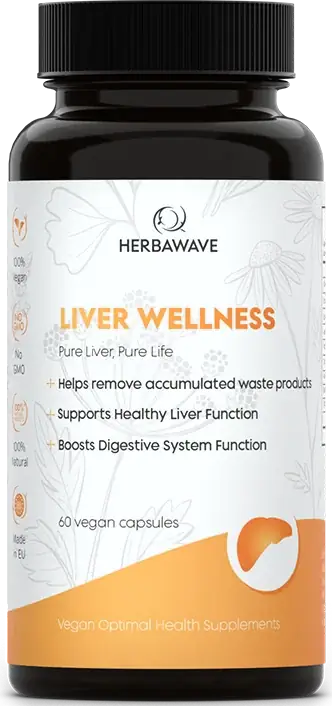
In the HerbaWave Liver Wellness formula, artichoke leaf extract is included at 150mg per serving alongside milk thistle (400mg), dandelion (150mg) and burdock root (150mg). This combination reflects the traditional European approach of combining multiple 'bitter liver herbs' in a single formula, with each contributing a different compound profile. Artichoke leaf provides the cynarin and chlorogenic acid fraction, while milk thistle contributes the silymarin complex, dandelion brings sesquiterpene lactones and inulin, and burdock root adds its own profile of arctiopicrin and polyphenols.
Beyond supplements, artichoke leaf extract appears in traditional European herbal liqueurs and aperitifs — most famously the Italian 'Cynar', which is named directly after the plant. The use of artichoke bitters as a pre-meal digestif is deeply rooted in Italian and French culinary culture and illustrates how the same bitter compounds that interest modern phytochemists have been valued in folk tradition for centuries. In some European countries, artichoke leaf tea is also consumed as a daily herbal infusion.
Safety and considerations
Artichoke leaf extract is generally well tolerated when taken at typical supplemental doses. The most commonly reported side effects in published literature are mild and transient gastrointestinal symptoms — including bloating, flatulence and mild stomach upset — which tend to resolve on their own. These effects are consistent with what would be expected from a concentrated bitter herbal extract and are not typically a cause for concern.
People with known allergies to plants in the Asteraceae (Compositae) family — such as ragweed, daisies, marigolds, chrysanthemums, or milk thistle — should exercise caution with artichoke, as cross-reactivity is theoretically possible. Anyone with a history of bile duct obstruction or gallstones should consult a doctor before taking artichoke leaf supplements, as the bitter compounds may theoretically stimulate bile production.
Artichoke leaf supplements are not generally recommended during pregnancy or breastfeeding — not because of identified harm, but because there is insufficient research to confirm safety in these populations. As with all herbal supplements, anyone who is pregnant, breastfeeding, planning to become pregnant, or taking prescription medication should consult their doctor before starting any new supplement.
Frequently asked questions
What is the difference between artichoke leaf and artichoke heart? ▾
The artichoke heart is the immature flower bud of the plant — the edible vegetable you find in the kitchen. Artichoke leaf, in herbal context, refers to the large basal leaves of the plant (the silvery-green leaves that grow from the stem). The bioactive compounds — cynarin, chlorogenic acid, luteolin glycosides and sesquiterpene lactones — are concentrated in the leaves, not in the edible flower head. When a supplement label says 'artichoke leaf extract', it means the basal leaves.
What is cynarin and why is it important? ▾
Cynarin (1,3-dicaffeoylquinic acid) is a caffeoylquinic acid that was first isolated from artichoke leaves in the mid-19th century. It is the compound most closely associated with artichoke in the phytochemical literature and the primary marker used to standardise artichoke leaf extracts. While chlorogenic acid is actually more abundant in artichoke leaves, cynarin has historically been the compound that defined the traditional use of artichoke leaf preparations in European herbalism.
Does artichoke have any EFSA-approved health claims? ▾
No specific EFSA-approved health claim currently exists for Cynara scolymus (artichoke). It is treated as a traditionally-used botanical in EU supplement regulation — its historical use is well-documented but the regulatory framework requires modern clinical trial data for specific health claims, and artichoke leaf has not yet received an approved claim. Many products that include artichoke instead carry EFSA claims for other ingredients in the formula.
Where does the artichoke in HerbaWave Liver Wellness come from? ▾
The artichoke leaf extract in Liver Wellness is sourced from commercially cultivated artichoke in the southern Thracian plain of Bulgaria. The Thracian plain has a warm, continental-Mediterranean transitional climate that is well suited to artichoke cultivation, and the leaves are harvested in summer and dried at low temperatures (below 40 degrees Celsius) to preserve the cynarin, chlorogenic acid and other phenolic compounds.
Can I take artichoke leaf extract alongside medication? ▾
Artichoke leaf extract is not known to have significant drug interactions at typical supplemental doses, but anyone taking prescription medication — particularly blood thinners, statins, or medications metabolised by the liver — should consult their doctor before starting any new herbal supplement. This is a general precaution that applies to all herbal products, not a specific identified risk with artichoke.
Is artichoke leaf the same as artichoke extract? ▾
Not exactly. 'Artichoke leaf' refers to the raw dried leaves of the plant, while 'artichoke leaf extract' is a concentrated preparation made by extracting the bioactive compounds from the dried leaves using water or a water-ethanol mixture. The extract contains a higher concentration of cynarin, chlorogenic acid and other compounds per gram than the raw leaf. Most supplements use the extract form rather than simply ground dried leaf, as the standardised extract provides a more consistent and predictable dose of the key compounds.
How long has artichoke been used in traditional medicine? ▾
The documented use of artichoke in Mediterranean medicine spans over 2,000 years. The ancient Greeks cultivated it and Theophrastus described it around 300 BC. The Romans — particularly Pliny the Elder (circa 77 AD) and Columella — wrote extensively about its culinary and medicinal uses. The tradition continued through medieval European herbalism, Italian and French Renaissance pharmacopoeias, and into the modern era. Artichoke leaf is one of the oldest continuously used European herbal botanicals.
What is the difference between artichoke and milk thistle? ▾
Both artichoke (Cynara scolymus) and milk thistle (Silybum marianum) belong to the Asteraceae family and both have a long history in European herbalism as 'liver herbs', but they are different plants with different active compound profiles. Artichoke leaf contains caffeoylquinic acids (cynarin, chlorogenic acid), luteolin glycosides and sesquiterpene lactones. Milk thistle seeds contain the silymarin complex — a group of flavonolignans including silybin A and B. Different parts of the plant are used (leaves for artichoke, seeds for milk thistle), and the compounds are chemically distinct. They are often combined in traditional European formulas precisely because their compound profiles are complementary rather than overlapping.