Ingredient reference
Lungwort
Pulmonaria officinalis · Boraginaceae
Native range
Deciduous forests of central and eastern Europe, including the Rhodope mountains
Part used
Leaves and aerial parts
Key compounds
Silica (silicic acid), Mucilage, Allantoin, Saponins, Flavonoids, Tannins
Traditional use
Used in European herbalism since at least the 16th century to support respiratory wellness
What is lungwort?
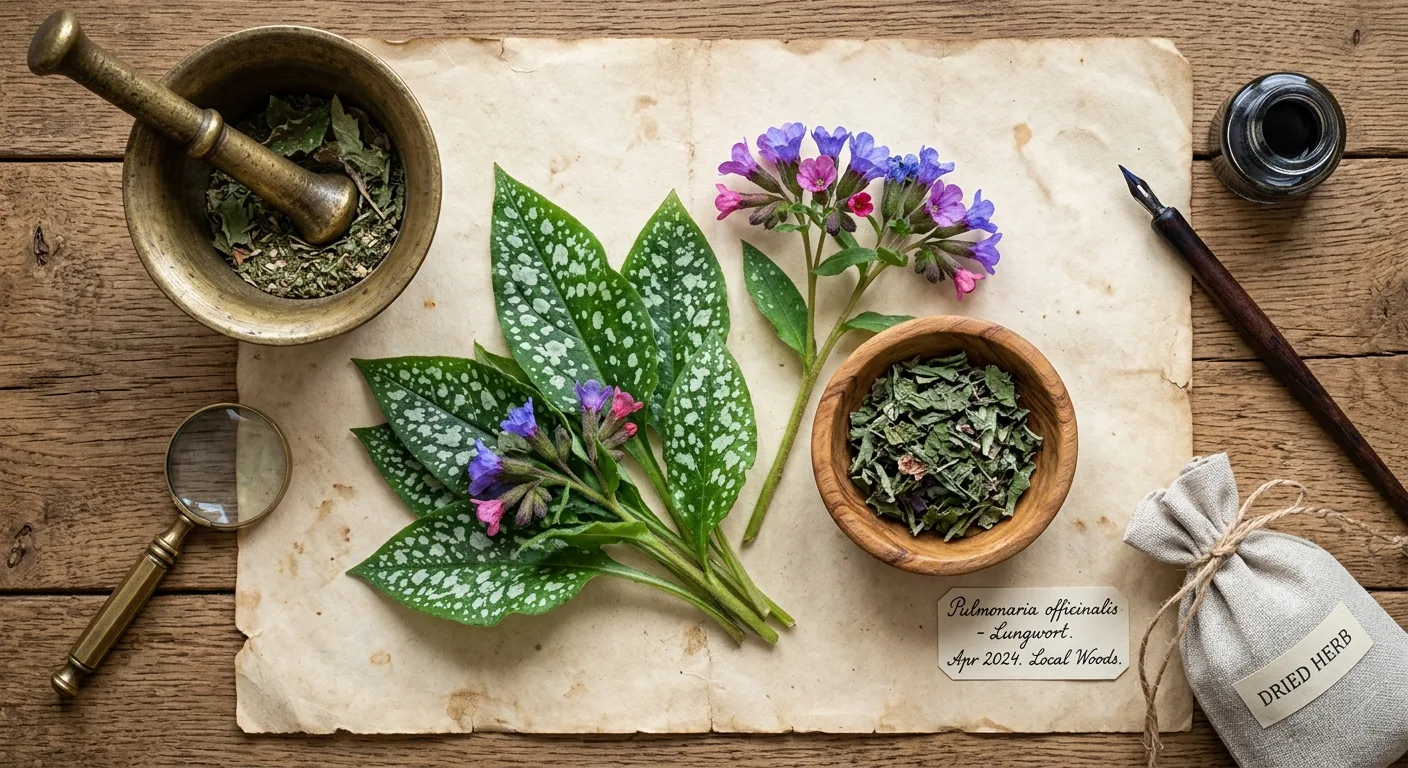
Lungwort (Pulmonaria officinalis) is a low-growing perennial plant of the Boraginaceae family — the same family as borage, comfrey and forget-me-not. It is one of the earliest spring flowers of European deciduous forests, blooming in March and April with clusters of small bell-shaped flowers that famously change colour as they age, opening pink and turning blue or violet over a few days. By late spring, after flowering, the plant produces large, distinctive leaves marked with irregular pale white or silvery spots — the feature that gave the plant both its English and Latin names.
The English name 'lungwort' and the Latin species name officinalis (meaning 'of the apothecary') both reflect a single medieval European belief: that the spotted appearance of the leaves resembled diseased lung tissue, and that the plant was therefore intended by nature for the lungs. This idea — known as the doctrine of signatures — was a guiding principle of medieval and Renaissance herbal medicine, where the visual appearance of a plant was thought to signal its medicinal use. The doctrine of signatures has long since been abandoned as a serious diagnostic method, but in lungwort's case the traditional use it generated has persisted for over four hundred years and is still the basis for the plant's modern role in European herbal practice.
In Bulgarian folk herbalism, the plant is most commonly known as медуница, although the older folk name белодробниче ('little lung') still appears in regional Bulgarian herbal literature and reflects the same lung-association as the English name. The plant is well-documented in 19th- and 20th-century Bulgarian ethnobotanical records as a traditional remedy of the Rhodope and Stara Planina mountain regions, where it grows naturally in the cool, shaded deciduous forests that dominate the lower slopes.
Where does lungwort grow?
Pulmonaria officinalis is native to the deciduous and mixed forests of central, eastern and south-eastern Europe — from the Carpathians and the Alps through the Balkans, with its native range stretching as far north as Scandinavia and as far south as the mountains of northern Greece. It is a shade-loving, moisture-loving plant that requires the cool, humid microclimate found beneath a closed forest canopy. It does not grow in open meadows, grasslands or sun-exposed slopes — which is why even within its native range it is patchy in distribution, restricted to the specific forest types that suit it.
In Bulgaria, lungwort is most abundant in the lower slopes of the Rhodope mountains, where the dense beech (Fagus sylvatica) and oak (Quercus) canopies create exactly the cool, shaded, moist conditions the plant needs. It also occurs in the Stara Planina range, the Pirin mountains, the Vitosha region near Sofia, and pockets of Strandzha in the south-east. The Rhodope populations are particularly significant because they grow in some of the largest unbroken broadleaf forest tracts left in Europe — these forests have been preserved for centuries by the geographic isolation of the region and by traditional sustainable use, so the lungwort that grows there is generally free of the agricultural and industrial pollutants that affect plants from more disturbed habitats.
Wild lungwort is harvested in late spring, after the flowers have faded but before the leaves have grown coarse and silica-heavy. Traditional Bulgarian collectors gather the leaves and the upper aerial parts of the plant by hand, taking only a portion of each stand to allow the perennial plant to regrow the following year. The harvested material is dried in the shade at low temperatures to preserve the silica, mucilage and flavonoid content — high temperatures or direct sunlight degrade both the active compounds and the visual quality of the dried herb.
History and traditional use
The earliest written references to lungwort as a medicinal plant come from the 16th century, during the great age of European herbal literature. The Italian physician and botanist Pietro Andrea Mattioli described it in his Commentarii (1554), one of the most influential herbal texts of the Renaissance, and the German Lutheran botanist Tabernaemontanus included it prominently in his Neuw Kreuterbuch (1588). Both authors associated lungwort specifically with the respiratory tract — Mattioli explicitly cited the doctrine of signatures, noting that the spotted leaves resembled lung tissue and reasoning that this visual similarity indicated the plant's intended use.
From the 17th century onwards, lungwort became a fixture of European herbal practice across the German-speaking lands, the Czech and Slovak regions, the Balkans and what is now Bulgaria. The English physician Nicholas Culpeper included it in his Complete Herbal (1653), recommending it for the lungs and the respiratory tract — and although Culpeper was already sceptical of the doctrine of signatures by his time, the empirical traditional use of lungwort had become well-established enough that he passed it on to the next generation of herbalists. By the 19th century, lungwort was a standard ingredient in the bronchial-tea blends sold by European pharmacies, where it was typically combined with other traditional respiratory herbs such as ribwort plantain (Plantago lanceolata), marshmallow root (Althaea officinalis) and licorice (Glycyrrhiza glabra).
In Bulgarian folk herbalism, lungwort has been used continuously since at least the medieval period, although written records are sparser than for the Mediterranean herbs because Bulgarian folk knowledge was transmitted primarily through oral tradition until the late 19th century. The plant is documented in the foundational Bulgarian ethnobotanical surveys of the early 20th century, where it appears as a common household remedy of the Rhodope, Stara Planina and Strandzha mountain villages — typically prepared as a tea from the dried leaves, often mixed with thyme (мащерка) and other local mountain herbs. The same regional preparation is still found in traditional Bulgarian herbalist shops today.
Phytochemistry: silica, mucilage and allantoin
Modern phytochemical analysis of lungwort has identified several distinct classes of bioactive compounds in the leaves and aerial parts of the plant. The most quantitatively significant is silicic acid (often called soluble silica), which can make up between 6% and 10% of the dry weight of the leaves — making lungwort one of the more silica-rich plants in European herbal medicine, alongside horsetail (Equisetum arvense) and stinging nettle (Urtica dioica). Silica gives lungwort its characteristic slightly rough texture when handled and contributes to the structural rigidity of the older leaves.
The second major class of compounds is mucilage — complex polysaccharides that swell into a soft gel in contact with water. The mucilage content of lungwort is lower than that of marshmallow root (Althaea officinalis), which can reach 35% of dry weight, but the soft, soothing physical property of the mucilage on contact with mucous membranes is the same. This is the property that gave both lungwort and marshmallow their respective traditional reputations as soothing herbs, and it is why they are often combined in European bronchial-tea formulations: lungwort and marshmallow contribute mucilage from different parts of the plant kingdom (lungwort from the leaves, marshmallow from the root), giving the formulation a broader range of mucilaginous polysaccharides than either could provide alone.
Lungwort also contains allantoin (a small organic compound also found in comfrey root and other Boraginaceae), saponins, flavonoids (kaempferol and quercetin glycosides), and a small amount of tannins. The plant is notable for being one of the few members of the Boraginaceae family in widespread herbal use that does not contain the hepatotoxic pyrrolizidine alkaloids found in some related species like comfrey (Symphytum officinale) — modern phytochemical surveys of Pulmonaria officinalis have found either no detectable pyrrolizidine alkaloids or only trace amounts well below the safety thresholds set by European regulatory bodies.
How is lungwort used today?
In modern European herbal practice, lungwort is most commonly used in two forms: as a dried leaf for tea preparation, and as a concentrated extract in supplemental capsules. The traditional tea preparation — pouring hot water over a teaspoon of dried leaves and steeping for 5 to 10 minutes — is still found in herbalist shops across central and eastern Europe, often as part of a broader respiratory-blend tea that combines lungwort with thyme, plantain, marshmallow and licorice. Concentrated extracts in supplemental form are a more recent development, allowing a higher and more consistent dose of the silica-mucilage-flavonoid profile per serving than would typically be obtained from a cup of tea.
Supplemental doses of lungwort extract typically range from 100mg to 500mg per serving in European products, with higher doses (around 500mg) reflecting the modern practice of using lungwort as a 'meaningful', full-strength botanical rather than a token addition to a multi-ingredient respiratory formula. Lungwort is generally taken with food, and there is no specific time-of-day recommendation — consistency over weeks and months matters more than precise timing.
It is worth noting, as with milk thistle and most other traditionally-used European medicinal plants, that the European Food Safety Authority (EFSA) has not yet issued a specific approved health claim for Pulmonaria officinalis. This places lungwort in the broad regulatory category of 'traditionally-used' botanical ingredients in EU supplement labelling — meaning the historical use is well-documented in European herbal literature going back centuries, but the modern regulatory framework requires a different kind of clinical evidence for specific medicinal claims, and lungwort has not yet been the subject of the large clinical trials that would be needed for an approved claim. Lungwort-containing products in Europe typically carry EFSA-approved claims that attach to other ingredients in the formula, such as biotin and vitamin B2 (which both contribute to the maintenance of normal mucous membranes), zinc and selenium (immune function), and vitamin E (cellular protection from oxidative stress).
Safety and interactions
Lungwort has a good safety profile in the herbal literature when used at typical supplemental doses. The plant has been used in European folk and professional herbal practice for over four hundred years without significant toxicity concerns, and modern phytochemical surveys confirm that, unlike some other members of the Boraginaceae family (notably comfrey, Symphytum officinale), lungwort does not contain meaningful amounts of the hepatotoxic pyrrolizidine alkaloids that are the main safety concern in this plant family. Studies that have specifically looked for these compounds in Pulmonaria officinalis have found either none detectable or only trace amounts well below regulatory safety thresholds.
There are no known significant drug interactions specifically associated with lungwort at typical supplemental doses. As a general precaution that applies to all herbal supplements, anyone taking prescription medication should consult their doctor before starting a new botanical product, particularly if they take medication with a narrow therapeutic window or that is heavily metabolised by the liver. People with allergies to other Boraginaceae plants (borage, comfrey, forget-me-not, viper's bugloss) should also exercise caution, as cross-reactivity is theoretically possible.
Lungwort is not generally recommended during pregnancy or breastfeeding — not because there is identified harm in these populations, but simply because the modern clinical research base on lungwort in pregnancy is too thin to confirm safety. As with all herbal supplements, anyone who is pregnant, breastfeeding, planning to become pregnant, or has a known medical condition should consult their doctor before starting a new supplement.
Frequently asked questions
What does the name 'lungwort' mean? ▾
The English name 'lungwort' and the Latin species name officinalis ('of the apothecary') both come from a medieval European belief — the doctrine of signatures — that the spotted appearance of the plant's leaves resembled diseased lung tissue, and that this visual similarity indicated the plant's intended medicinal use. The doctrine of signatures has long since been abandoned as a diagnostic method, but the traditional use it generated has persisted continuously for over four hundred years. The Bulgarian common name медуница refers to the plant's role as an early-spring source of nectar for bees, while the older Bulgarian folk name белодробниче ('little lung') reflects the same lung-association as the English name.
Where does lungwort grow naturally? ▾
Pulmonaria officinalis is native to the deciduous and mixed forests of central, eastern and south-eastern Europe — from the Carpathians and Alps through the Balkans, with its range extending as far north as Scandinavia and as far south as the mountains of northern Greece. In Bulgaria, it is most abundant in the lower slopes of the Rhodope mountains, where the dense beech and oak canopies create the cool, shaded, moist conditions the plant prefers. It also grows in Stara Planina, Pirin, the Vitosha region near Sofia, and parts of Strandzha. It is a strictly forest-dwelling plant — it does not grow in open meadows or sun-exposed slopes.
Is lungwort safe? Doesn't the Boraginaceae family contain toxic alkaloids? ▾
This is an important and reasonable concern. The Boraginaceae family does include some species, most notably comfrey (Symphytum officinale), that contain hepatotoxic pyrrolizidine alkaloids — these are the compounds responsible for the safety concerns around comfrey. However, modern phytochemical surveys of Pulmonaria officinalis have found either no detectable pyrrolizidine alkaloids or only trace amounts well below the safety thresholds set by European regulatory bodies. Lungwort has been used in European herbal practice continuously for over four hundred years without the toxicity concerns associated with comfrey, and at typical supplemental doses it has a good safety profile.
What dose of lungwort should I take? ▾
European supplemental doses of lungwort extract typically range from 100mg to 500mg per serving. The traditional 'meaningful' supplemental dose — used in formulas where lungwort is the cornerstone ingredient rather than a token addition — is at the higher end of this range, around 500mg of dried-leaf-equivalent extract per day, taken with food. Always follow the dosage recommendations on the label of the specific product you are taking.
Does lungwort have any EFSA-approved health claims? ▾
No specific EFSA-approved health claim currently exists for Pulmonaria officinalis (lungwort). It is treated as a traditionally-used botanical in EU supplement regulation — its historical use in European herbal practice is well-documented going back to the 16th century, but the modern regulatory framework requires a different kind of clinical evidence for specific medicinal claims. Lungwort-containing supplement products in Europe typically carry EFSA-approved claims that attach to other micronutrients in the formula, such as biotin and vitamin B2 (which both contribute to the maintenance of normal mucous membranes), zinc and selenium (which contribute to normal immune function), and vitamin E (which contributes to the protection of cells from oxidative stress).
Is lungwort the same plant as the lungwort sold as a tea? ▾
Yes — Pulmonaria officinalis is the same plant whether it is sold as a dried leaf for tea preparation or as a concentrated extract in capsules. The two forms differ in dose and consistency: a cup of lungwort tea typically delivers a relatively small and variable amount of the active compound profile, while a 500mg standardised extract delivers a much higher and more consistent dose per serving. Both forms have a long history of use in European herbal practice, and both are still available in central and eastern European herbalist shops today.
Can I take lungwort during pregnancy or breastfeeding? ▾
Lungwort is not generally recommended during pregnancy or breastfeeding — not because there is identified harm in these populations, but because the modern clinical research base on lungwort in pregnancy is too thin to confirm safety. As with all herbal supplements, please consult your doctor before taking any supplement if you are pregnant, breastfeeding or planning to become pregnant.
How is lungwort different from other respiratory herbs like ribwort plantain or marshmallow? ▾
All three plants — lungwort (Pulmonaria officinalis), ribwort plantain (Plantago lanceolata) and marshmallow root (Althaea officinalis) — are traditional European herbs used historically for the respiratory tract, and all three contain mucilaginous compounds that contribute to their soothing properties. They differ in their secondary phytochemistry: lungwort is unusually rich in silica (6-10% of dry weight), ribwort plantain contains the iridoid glycoside aucubin, and marshmallow root has the highest mucilage content of any common European herb (up to 35% of dry weight). This is why they are often combined in traditional European bronchial-tea formulations rather than used in isolation — each contributes a different chemical profile to the overall preparation.