Ingredient reference
Marshmallow Root
Althaea officinalis · Malvaceae
Native range
Europe, western Asia and North Africa -- grows wild in damp meadows and along riverbanks throughout Bulgaria
Part used
Root
Key compounds
Mucilage (arabinan, galacturonan), Flavonoids, Phenolic acids, Scopoletin
Traditional use
Used in European herbalism since Hippocrates for soothing the respiratory tract and mucous membranes
What is marshmallow root?
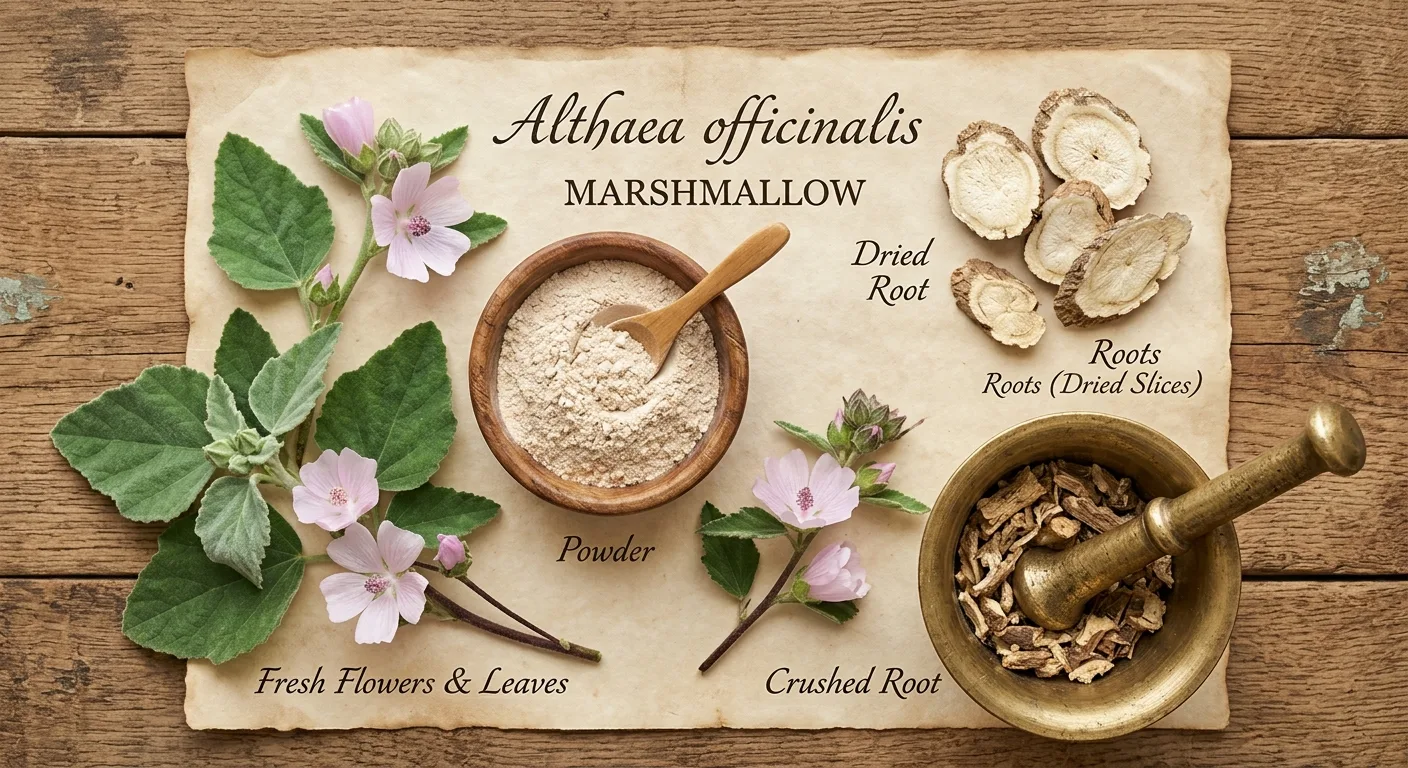
Marshmallow root is the dried root of Althaea officinalis, a soft, velvety perennial plant of the Malvaceae family -- the same family as hollyhocks, hibiscus and cotton. The plant grows up to 1.5 metres tall, with thick, fleshy stems covered in fine, downy hairs, large soft leaves and delicate pale pink or white flowers that bloom in late summer. It is the root, harvested in autumn from two- to three-year-old plants, that is prized in herbalism -- and it is exceptional among plant materials for one reason: its extraordinarily high mucilage content.
Mucilage can make up as much as 35% of the dry weight of the root. It is a complex polysaccharide -- a long-chain sugar molecule -- that swells dramatically on contact with water and forms a soft, slippery gel. This physical property, more than any specific pharmacologically active compound, is the basis for marshmallow root's centuries-old reputation in herbalism. When mucilage comes into contact with a mucous membrane, it forms a thin, soothing layer -- which is why traditional European herbalists reached for marshmallow root whenever the throat or respiratory tract needed calming.
The Latin name Althaea derives from the Greek word altho, meaning 'to heal' or 'to cure'. The species name officinalis tells us this plant was stocked in the officina -- the dispensary or pharmacy of a medieval monastery. The English word 'marshmallow' simply describes where the plant likes to grow: in the marsh, in the mallow family. And yes, the confectionery marshmallow was originally made from the mucilage of this very root -- 19th-century French confectioners whipped the root extract with sugar and egg whites to produce the soft, pillowy sweet. Modern marshmallows use gelatin instead, but the name survives.
Where does marshmallow root grow?
Althaea officinalis is native to a broad belt stretching from western Europe through the Mediterranean basin, the Balkans, the Caucasus and into central Asia. Unlike many herbs that favour dry, sun-baked hillsides, marshmallow actively seeks moisture. It grows in damp meadows, ditches, the edges of salt marshes, and above all along riverbanks -- anywhere where the soil is consistently moist, slightly saline and rich in nutrients. This is a plant of river valleys, floodplains and coastal wetlands.
In Bulgaria, marshmallow grows wild across the lowland river valleys of Thrace, along the banks of the Maritsa, Tundzha and Struma rivers, and in the damp meadows of the Danube plain in the north. The Thracian lowlands offer the ideal combination of fertile alluvial soils, warm summers and reliable moisture from the river systems. Bulgarian harvesters traditionally dig the roots in October and November, after the above-ground parts have died back and the plant has concentrated its resources underground. The roots are washed, peeled, sliced into segments and dried at low temperatures to preserve the mucilage.
History and traditional use
Marshmallow root has one of the longest documented histories of any European medicinal plant. Hippocrates, writing in the 5th century BC, recommended a decoction of the root for bruises and as a wound poultice. The Roman physician Pliny the Elder (1st century AD) described its soothing properties for the throat and recommended chewing the root. Dioscorides, in De Materia Medica, listed it among remedies for the respiratory tract, coughs and irritation of the mucous membranes. The consistent thread across two and a half millennia is always the same: the soft, calming mucilage of the root.
In the medieval period, marshmallow was cultivated in virtually every European monastery garden. It appears in Charlemagne's Capitulare de villis (circa 800 AD), the administrative decree that listed the plants every imperial estate was required to grow. By the Renaissance, the root was a staple of every European apothecary's shelf. The 16th-century German herbalist Hieronymus Bock recommended it for dry coughs; the English physician Nicholas Culpeper, writing in the 1650s, praised the root's ability to ease rawness and roughness of the throat.
Bulgarian folk medicine has its own long tradition with marshmallow. In rural Thrace, village healers prepared cold-water infusions of the dried root -- a technique that extracts the mucilage without destroying it with heat -- and used the resulting thick, syrupy liquid for sore throats and irritated mucous membranes. The Bulgarian folk name 'лечебна ружа' literally means 'healing mallow', reflecting the plant's central role in traditional village herbalism.
Phytochemistry: what is in the root?
The dominant constituent of marshmallow root -- and the one that defines its character in herbalism -- is mucilage. Mucilage content in the dried root ranges from about 10% to 35% depending on the age of the plant, the soil conditions and the time of harvest. Chemically, marshmallow mucilage is a heterogeneous polysaccharide composed principally of arabinan and galacturonan units, with smaller amounts of rhamnose, galactose and glucuronic acid. In simple terms, it is a very long sugar chain that loves water: when moistened, the polysaccharide chains unfold and trap water molecules, forming a thick, viscous gel.
Beyond mucilage, the root contains a range of secondary metabolites. Flavonoids -- including hypolaetin-8-glucoside, isoquercitrin and kaempferol derivatives -- are present at low but detectable concentrations. Phenolic acids such as caffeic acid, p-coumaric acid and ferulic acid contribute to the overall antioxidant profile. Scopoletin, a coumarin derivative, has been identified in small amounts. The root also contains pectin, starch and asparagine (an amino acid first isolated from the closely related Asparagus, whose name shares the same root).
It is worth emphasising that the phytochemistry of marshmallow root is unusual among medicinal plants. Most herbal medicines derive their reputation from a specific bioactive compound -- silymarin in milk thistle, glycyrrhizin in licorice, aucubin in plantain. In marshmallow, the primary 'active' is a physical phenomenon: the gel-forming mucilage. This is not a compound that binds to a receptor or inhibits an enzyme; it is a material property. That distinction matters, because it means marshmallow root's traditional use rests on a readily observable, reproducible physical effect rather than on a complex pharmacological mechanism.
How is marshmallow root used today?
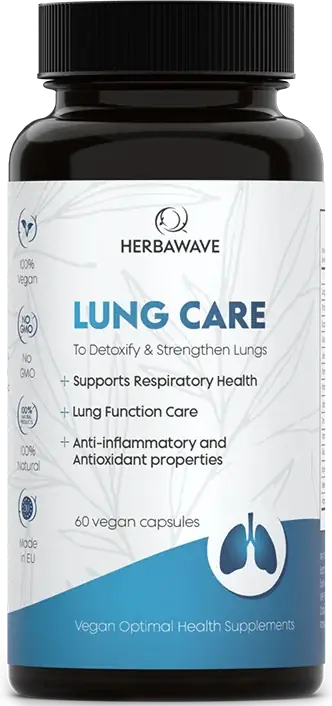
In European supplement markets, marshmallow root appears in two main forms. First, as a standalone herbal product -- typically a cold-maceration tea or a powder in capsules -- taken for the throat and respiratory tract. Second, as a supporting ingredient in multi-herb respiratory or digestive formulas, where its mucilage complements the action of other botanicals. In HerbaWave's Lung Care formula, for example, marshmallow root is included at 70mg alongside lungwort, ribwort plantain, licorice and eucalyptus. The mucilage of the marshmallow root works alongside the mucilage of the lungwort and plantain -- a traditional pairing that European herbalists have used for centuries.
The traditional method of preparing marshmallow root at home is cold maceration: the dried, sliced root is soaked in cold or room-temperature water for several hours (typically 4 to 8 hours or overnight). This cold extraction method is considered superior to hot infusion for marshmallow because boiling can break down the long polysaccharide chains and reduce the gel-forming capacity. The resulting liquid is viscous, slightly sweet, and has been used in European folk medicine as a gargle, a demulcent drink, or applied externally to irritated skin.
Safety and practical considerations
Marshmallow root has an excellent safety profile. It has been consumed as food and medicine across Europe for millennia, and no significant adverse effects have been documented at standard supplemental doses. The European Medicines Agency (EMA) lists Althaea officinalis root as a traditional herbal medicinal product with 'well-established use' for the symptomatic treatment of oral or pharyngeal irritation and associated dry cough, and as a 'traditional use' product for mild gastrointestinal complaints.
One practical consideration: because mucilage can form a coating in the digestive tract, marshmallow root may theoretically slow the absorption of other oral medications. For this reason, people taking prescription drugs are generally advised to separate marshmallow root intake from their medication by at least two hours. Pregnant and breastfeeding women should consult a healthcare professional before taking marshmallow root supplements, as with all herbal products -- not because harm has been identified, but because specific safety data for these populations is limited.
From a regulatory perspective, marshmallow root sits in a similar position to many traditional European botanicals: it has centuries of documented use, a clear EMA monograph, and a well-understood mechanism (physical mucilage), but no specific EFSA-approved health claim. This does not mean it is ineffective -- it means that the EU regulatory framework, which requires modern randomised clinical trial data for health claims, has not yet been applied to marshmallow root in the same way it has to vitamins and minerals. The plant remains one of the most respected respiratory herbs in European tradition.
Frequently asked questions
What is the difference between marshmallow root and marshmallow leaf? ▾
Both the root and leaf of Althaea officinalis contain mucilage, but the root has a significantly higher concentration -- up to 35% of dry weight compared to about 6-9% in the leaves. Traditional European herbalism generally favours the root for the respiratory tract and the leaf for milder applications. In supplement formulas, the root is the most commonly used part.
Is the confectionery marshmallow still made from the plant? ▾
No. The original 19th-century French marshmallow confectionery (pate de guimauve) was indeed made by whipping Althaea root extract with sugar and egg whites. Today, commercial marshmallows use gelatin or modified starch instead -- the plant has been entirely replaced. However, some artisanal confectioners in France still produce traditional pate de guimauve using the real root extract.
Why is cold maceration recommended instead of hot water? ▾
Boiling or very hot water can partially break down the long polysaccharide chains that make up mucilage, reducing the gel-forming capacity. Cold or room-temperature maceration (4-8 hours) extracts the mucilage intact, producing a thicker, more viscous preparation. This is specifically important for marshmallow root -- for herbs where the active compounds are not polysaccharides, hot infusion is perfectly fine.
What dose of marshmallow root is used in supplements? ▾
Doses vary widely depending on whether marshmallow root is the lead ingredient or a supporting one. Standalone marshmallow root supplements typically provide 400-1500mg per daily serving. In multi-ingredient respiratory formulas, lower doses of 50-200mg are common, relying on the complementary mucilage from other botanicals in the blend. HerbaWave's Lung Care includes 70mg of Althaea officinalis alongside five other respiratory herbs.
Does marshmallow root have any EFSA-approved health claims? ▾
No specific EFSA-approved health claim currently exists for Althaea officinalis (marshmallow root). It is classified as a traditionally-used botanical in EU supplement regulation. The EMA (European Medicines Agency) does recognise it as a traditional herbal medicine for oral and pharyngeal irritation and associated dry cough, but this is a separate regulatory pathway from EFSA health claims.
Can I take marshmallow root alongside medication? ▾
Because the mucilage in marshmallow root can form a gel layer in the digestive tract, it may theoretically slow the absorption of oral medications taken at the same time. The standard precaution is to separate marshmallow root from any prescription medication by at least two hours. If you are taking prescription drugs, consult your doctor or pharmacist before adding marshmallow root to your routine.
Is marshmallow root safe during pregnancy? ▾
There is no evidence of harm from marshmallow root during pregnancy, but there is also insufficient clinical research to confirm safety in pregnant or breastfeeding women specifically. As with all herbal supplements, please consult your doctor before taking marshmallow root if you are pregnant, breastfeeding or planning pregnancy.
Where does HerbaWave source its marshmallow root? ▾
The marshmallow root in HerbaWave's Lung Care formula is sourced from Bulgaria, specifically from the lowland river valleys of southern Bulgaria where Althaea officinalis grows wild in the damp alluvial meadows. The roots are harvested in autumn when mucilage content is at its peak, then dried at low temperatures to preserve the gel-forming polysaccharides.